Protect the useful part of a short trip by limiting drive load, securing the first night and building a real departure buffer.
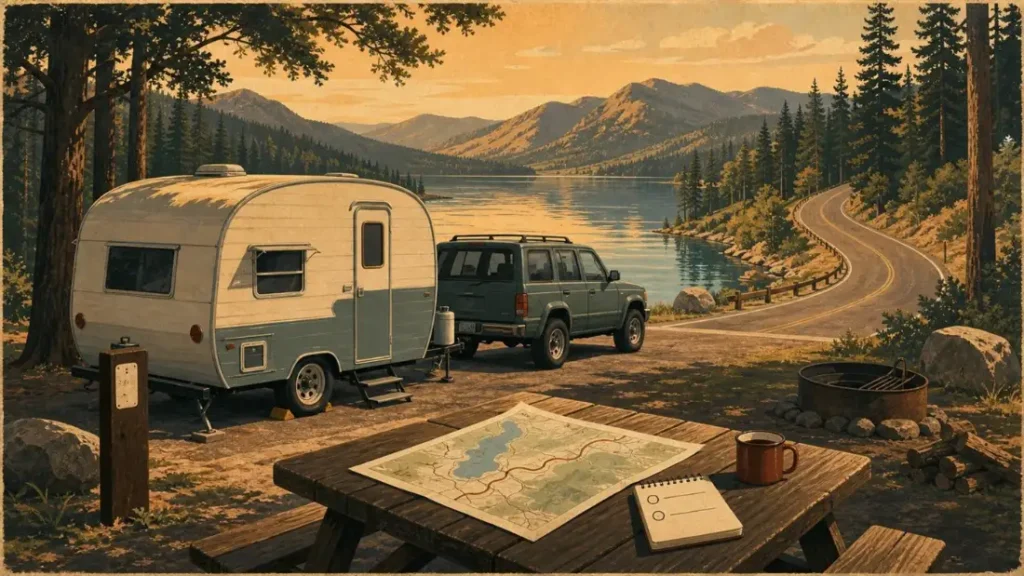
A weekend has roughly one long drive in it, not two. The planning card exists because the second drive is where most two-night trips fall apart. Illustration: Ticheka Outdoors
Human-reviewed editorial editionPlanning framework reviewed August 1, 2026Recheck official conditions before travel.
The 48-hour test
A weekend trip needs a different shape than a long road trip. Count the time from leaving home to leveling the rig—not just map drive time. Fuel, food, dump/fill, traffic, slower towing speed and check-in constraints all consume the same short window.
Confirmed first night, arrival before dark, one primary activity and one flexible backup.
Amber
Late arrival or tight route
Add a gateway overnight, remove a must-do activity or leave earlier. Do not spend the buffer twice.
Red
Unverified site or access
No exact equipment fit, no arrival plan or a route dependent on uncertain conditions: stop and redesign.
A practical 72-hour structure
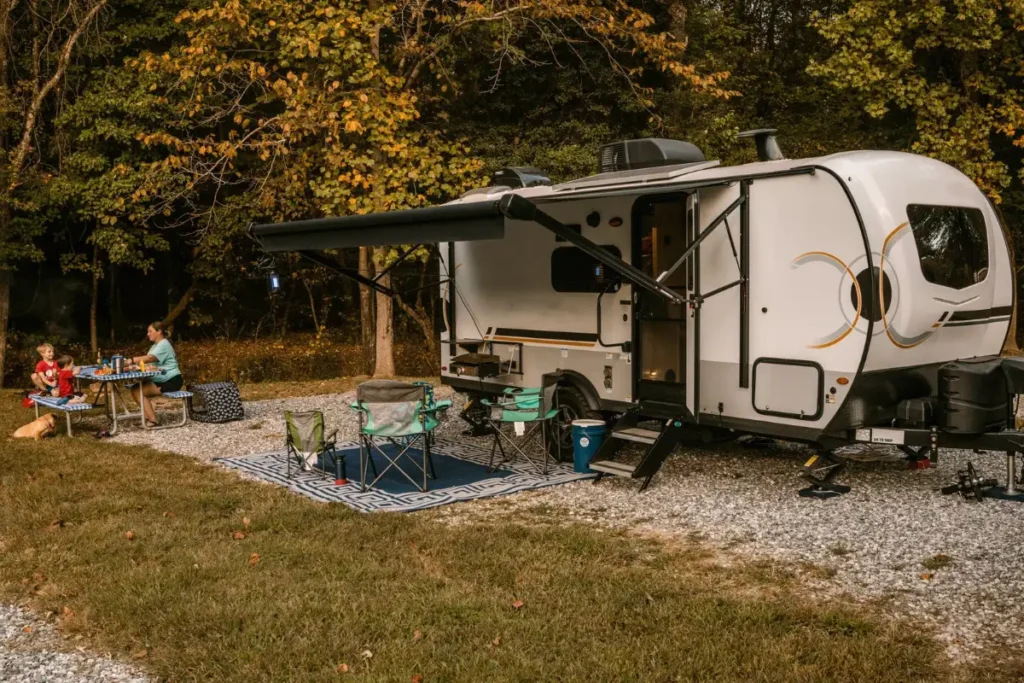
A weekend site only works if the pad, the awning side and the picnic table line up. Awnings deploy on the door side, so a site that reads “spacious” can still put your living space against a road or a neighbor’s hookup post. Site photos on the reservation page usually show which side is open. Photo: Adobe Stock
Day 1: travel, fuel before the final approach, check in and keep the evening simple.
Day 2: one high-value park loop or activity plus a weather/traffic alternative.
Day 3: short morning, tank/gear check, departure before the return route becomes fragile.
Build the budget before booking
Use the RV trip cost calculator with round-trip miles, real loaded MPG, campground nights and fixed costs. Add a separate maintenance and emergency reserve instead of hiding it inside the fuel estimate.
Most disappointing weekends are decided before departure, by a distance chosen from a map rather than from experience. A tow vehicle and trailer do not cover ground the way a car does: you are slower on grades, slower through towns, and you stop more often. A useful planning rule is to assume your towing average is meaningfully below the posted limit once fuel stops, food and traffic are included, and then design the weekend around that number rather than around the optimistic one.
Work it out once and reuse it forever. Take your last two towing trips, divide the door-to-door distance by the door-to-door elapsed time — including every stop — and you have your personal towing average. Multiply that by the number of hours you are willing to drive on a Friday evening and you have your weekend radius. Draw it on a map. Everything inside the circle is a candidate; everything outside it is a long weekend, not a weekend.
Two adjustments matter. Add time, not distance, for elevation: a climb that looks like an hour on a routing app can take considerably longer with weight behind you. And subtract from the radius for the return leg, because Sunday traffic near popular parks is consistently worse than Friday traffic away from them.
Solve the first night before anything else
The first night is the only part of a weekend that cannot be improvised. Activities can be swapped, routes can be changed, but arriving at 9pm without a confirmed site turns a short trip into a search. Book the first night before you plan anything else, and prefer a site you can reach in daylight even if it is not the most scenic option in the area.
Plan to arrive in daylight; an unfamiliar site is much harder to back into and level after dark. Levelling, hookups, and reading site markers are all substantially harder in the dark, most campgrounds have quiet hours that restrict what you can do on arrival, and unfamiliar campground roads with low branches and tight turns are exactly where towing damage happens. If your realistic arrival is after dark, the correct fix is to leave earlier or to stop short on the first night, not to drive faster.
The one-hour rule. Plan to arrive at least one hour before local sunset. If your route planning cannot produce that, the destination is too far for this weekend. Move it to the long-weekend list and pick something inside your radius instead.
Base camp or move the rig
For a two-night trip, the answer is almost always a single base. Every repositioning of the rig costs you the pack-down, the drive, the levelling and the set-up again — realistically an hour and a half of the weekend for a move that might save twenty minutes of driving to a trailhead. Park once, and use a tow vehicle, a shuttle or a bicycle for everything else.
Moving becomes defensible on three nights or more, and only when the second location genuinely unlocks something the first cannot reach. If you are considering it, apply a simple test: would you make this move if it required unhitching, driving and re-hitching twice? If the answer is no, stay put.
Build the plan that survives a closure
Short trips have no slack, so a single road closure or a weather day can consume the whole weekend. The defense is not a more detailed plan — it is a plan with a documented alternative at each of the three points that actually break.
The approach route. Identify a second way in that does not use the same pass, bridge or seasonal road. Check it before you leave, not from the shoulder.
The main activity. Pair every weather-dependent plan with an indoor or low-elevation alternative in the same area, so a bad forecast changes the day rather than the trip.
The departure. Know a return route that still works if the road you arrived on closes overnight. This is the contingency people skip and the one that costs a Monday.
Run the official notices for your destination before you commit, not the morning you leave: our national park RV alert check opens current road, fire and vehicle restrictions straight from the responsible park.
The twenty-minute departure routine
Weekend trips fail on small omissions more than on big planning errors, because there is no spare day to absorb them. A fixed pre-departure routine removes almost all of them, and it does not need to be elaborate.
Water and tanks. Leave with fresh water aboard and holding tanks empty. Doing this at home is free; doing it en route costs you an hour and a detour.
Tires, cold. Pressures on the rig and the tow vehicle before you move, not at the first fuel stop.
The hitch, twice. Coupler latched and pinned, safety chains crossed, breakaway cable attached to the vehicle rather than to the chains, lights tested by a second person.
Height written down. Your loaded height on a note on the dashboard, so it is never a guess at a low bridge.
Confirmation screenshot. The reservation, including its equipment allowance, saved offline where signal is unreliable. If the weekend depends on staying connected at all, work through planning an RV internet setup rather than trusting campground Wi-Fi.
The full version, formatted so you can print it and keep it in the rig, is our RV camping checklist.
Print this guide
This guide prints cleanly from any browser — no plugin, no download, no sign-up. Navigation, images and site links are hidden automatically in the printed version.
Want a PDF instead? Use the same print button and choose Save as PDF as your destination in the print dialog. That gives you an offline copy on your phone.
Tip: print the 72-hour structure and the twenty-minute departure routine. Those are the two parts you actually reread on the road.
Frequently asked questions
How far is too far for a two-night RV trip?
If the drive is more than about a third of your total awake hours for the trip, you are buying travel rather than camping. Use your measured towing average and the radius method above instead of a fixed mileage figure.
Is a one-night RV trip worth it?
Occasionally, and only within an hour of home. Below that distance the set-up and pack-down overhead consumes most of the value.
Should I reserve a campsite for a weekend trip or take my chances?
Book. First-come sites near popular parks are effectively fully taken on summer Fridays, and the failure mode is severe: no site, after dark, with a rig you cannot easily turn around.
What should I do if the forecast turns bad two days before a weekend trip?
Change the activity, not the trip, unless the weather affects the road. Weather that closes a pass is a cancellation; weather that makes a hike unpleasant is a different day plan.
Reservation windows, first-come availability and road status are set locally and change without notice. Confirm every date and rule on the managing agency page before you leave.
Next step Lock the dates first, then the rig limits: check the booking windows guide for release dates, then the rig measurement guide before you filter campgrounds by length.
Manage Consent
To provide the best experiences, we use technologies like cookies to store and/or access device information. Consenting to these technologies will allow us to process data such as browsing behavior or unique IDs on this site. Not consenting or withdrawing consent, may adversely affect certain features and functions.
Functional
Always active
The technical storage or access is strictly necessary for the legitimate purpose of enabling the use of a specific service explicitly requested by the subscriber or user, or for the sole purpose of carrying out the transmission of a communication over an electronic communications network.
Preferences
The technical storage or access is necessary for the legitimate purpose of storing preferences that are not requested by the subscriber or user.
Statistics
The technical storage or access that is used exclusively for statistical purposes.The technical storage or access that is used exclusively for anonymous statistical purposes. Without a subpoena, voluntary compliance on the part of your Internet Service Provider, or additional records from a third party, information stored or retrieved for this purpose alone cannot usually be used to identify you.
Marketing
The technical storage or access is required to create user profiles to send advertising, or to track the user on a website or across several websites for similar marketing purposes.

 Skip to content