
 Skip to content
Disclosure: some links in this guide go to Amazon. Ticheka Outdoors is a participant in the Amazon Services LLC Associates Program. As an Amazon Associate I earn from qualifying purchases, at no extra cost to you. Affiliate links never change what we include, how we rank it, or what we say about it. See our affiliate disclosure and editorial policy.
Quick answer
Your trip length is limited by whichever capacity reaches its planning limit first — fresh, gray, or black — and by where your next legal dump and refill points actually are. Which tank binds depends on your rig and behavior; gray water is a common risk on shower-heavy trips, but it is not a universal default. The reliable sequence: identify the campground’s official service level (full hookups, dry with dump station, or primitive with seasonal spigots), run conservative tank math against your rig’s real capacities, then place legal dump and potable-refill stops on the route before departure. In National Park System units, liquid waste from a trailer or vehicle must go to a facility provided for that purpose; on National Forest System lands, sewage and wastewater must be removed from the site or placed where the agency provides. Those are different regulations with different scopes, both linked below.
Step 1: Decode the campground’s service level before anything else
Campground listings use service terms loosely; official records are precise. This table maps the service levels you’ll encounter to what each one means for your tanks, with a verified official example for each. Examples were checked August 2, 2026 and are illustrations of service categories, not a facilities directory — always read your own campground’s record.
| Service level | What’s provided | What it means for your tanks | Verified official example |
|---|---|---|---|
| Full hookups at the site | Sewer, water, and electric connections at your pad | You can normally reset tanks at the site, but still arrive in a known state and verify that every listed service is operating at check-in | Colter Bay RV Park, Grand Teton: 112 full-hookup sites with sewer, water, and 20/30/50-amp electric (NPS official page; Recreation.gov record); Fishing Bridge RV Park is Yellowstone’s only full-hookup campground (NPS camping page) |
| Dry camping with dump station and potable water on site | No hookups at the pad; shared dump and fill points in the campground | Your tanks carry between service visits, but an operating on-site station can let you reset without leaving | Colter Bay Campground, Grand Teton: no hookups at sites, complimentary dump station and potable water filling station (Recreation.gov record; operator’s official page); in Yellowstone, the NPS table shows dump stations at the five large campgrounds (NPS camping page) |
| Primitive: vault toilets, seasonal spigots, no dump | Drinking water may be available in season; no waste service at the site | You arrive with an appropriate fresh supply and empty waste tanks, and everything you generate leaves with you; the season matters as much as the facility | Lewis Lake’s official record conflicts internally: its overview lists water into October 1, while its important notice says potable water is available through September 30 at the latest and may shut earlier. Use September 30 as the conservative outer date and verify before travel (Recreation.gov record). Slough Creek says potable water “may be available, seasonal” (Recreation.gov record) |
| No services (dispersed/boondocking) | Nothing provided | Fully self-contained; every gallon in and out is yours to plan, and disposal happens only at an authorized facility elsewhere | On National Forest System lands, federal regulation requires removing sewage and wastewater from the site or placing it in receptacles or locations provided for that purpose (36 CFR 261.11) |
Two traps hide in this table. First, a campground with a dump station does not necessarily have hookups — most don’t — so “has RV services” in casual descriptions can mean very different things. Second, service level is seasonal: the same primitive campground is a different logistical problem in June than in late September if its water window has closed. Our park-by-park records in the campground finder note service fields exactly as the official record states them.
Step 2: Know your tank layout — and which capacity binds first
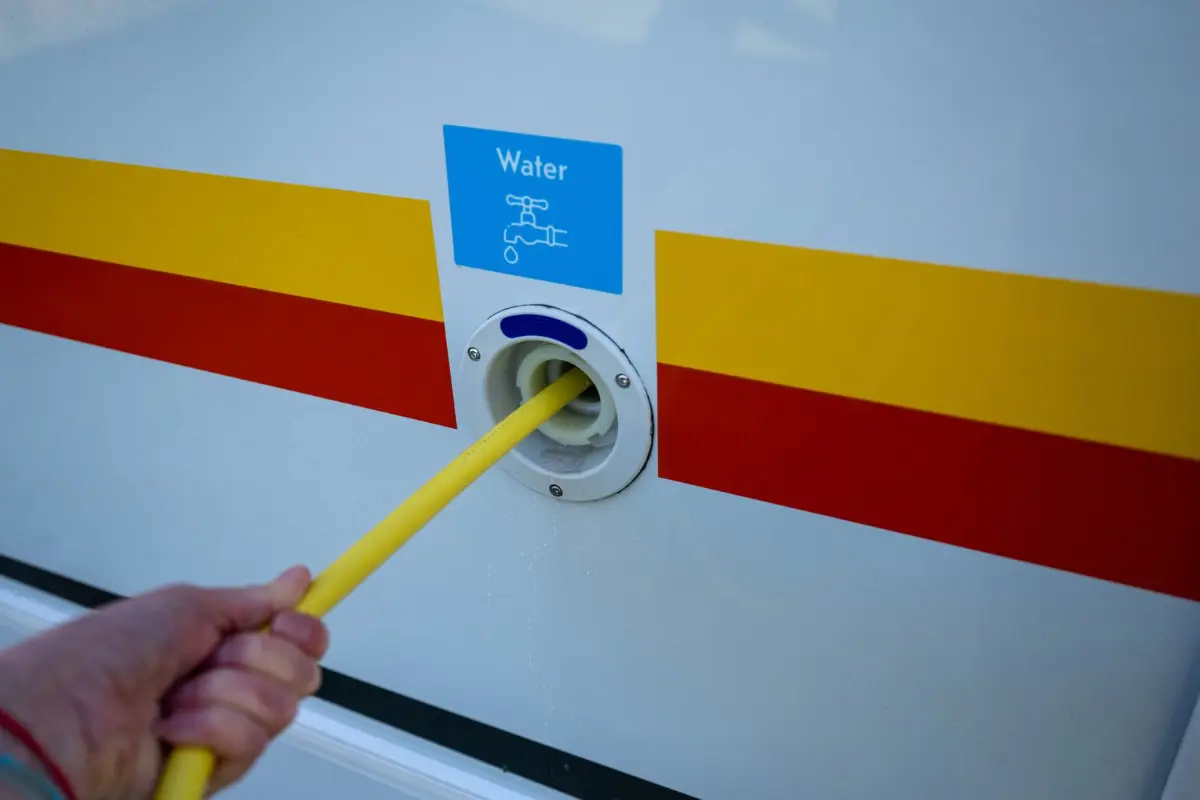
For rigs with separate fresh, gray, and black tanks, each system fills or empties at a different rate. Some compact rigs combine or omit tanks, so use the actual plumbing and capacities in your owner’s manual rather than assuming this three-tank layout.
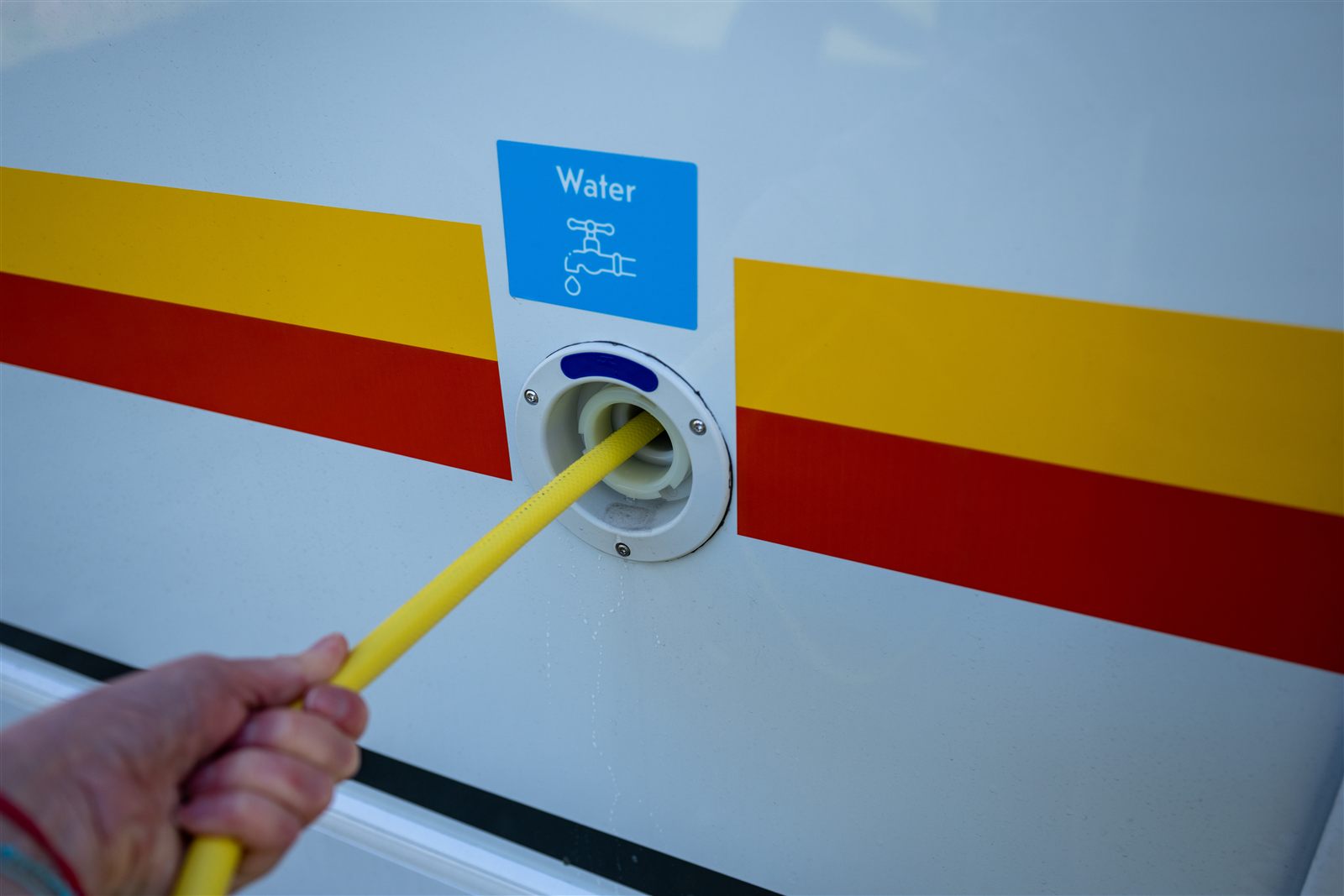
- Fresh tank: everything you drink, cook with, wash with, and flush with. For conservative planning, Ticheka treats 90 percent of rated capacity as usable to allow for pump-pickup uncertainty and water the system may not deliver. This is an editorial convention, not a manufacturer specification.
- Gray tank: sink and shower drainage. Gray inflow depends on how much shower, dish, handwashing, and cooking water actually goes down a drain; it can bind first on wash-heavy trips but not on every rig.
- Black tank: toilet flush water plus human waste. Flush-water estimates alone cannot model total black volume, so use your rig’s observed monitor trend or measured service history and preserve a buffer.
The planning rule that follows: your trip is limited by the earliest capacity to reach its conservative threshold, not by an average. Compare fresh draw, estimated gray inflow, observed black accumulation, and the next confirmed service point.
Step 3: The pre-trip calculation framework
These per-person daily figures are Ticheka planning assumptions for conservative estimating — editorial defaults, not standards published by any agency. Adjust them to how your crew actually camps, and always round consumption up.
- Drinking and cooking: 1.5 gallons per person per day
- Dishes (washed conservatively, basin method): 2.5 gallons per crew per day
- Navy shower (wet, off, soap, rinse): 4 gallons per shower
- Toilet flushing: 0.75 gallons per person per day
- Buffer: keep 20 percent of every tank in reserve — for delays, spills, and the day the dump station you counted on is closed
Never reduce drinking water to make the estimate fit. Increase the drinking allowance for heat, altitude, medical needs, children, and pets; conserve through showers, dishwashing, or a planned refill instead.
The fresh-water method deliberately stacks two conservative allowances: rated capacity × 0.90 for assumed usable capacity, then × 0.80 to hold 20 percent of that usable amount in reserve. The planning budget is therefore 72 percent of the rated fresh tank. If your own measured usable capacity is reliable, replace the 0.90 convention with that number and keep the separate trip buffer.
The framework, in four lines:
- Daily fresh draw = drinking/cooking + dishes + showers + flushing, for your crew size.
- Fresh planning days = (usable fresh × 0.8) ÷ daily fresh draw. One planning day means one 24-hour consumption cycle.
- Gray planning days = (gray capacity × 0.8) ÷ estimated daily gray inflow. Count shower water, dishwater, handwashing, and any cooking water actually drained; subtract only water you know is consumed or routed to black.
- Black planning days come from your own observed daily gauge or service history because human waste adds volume beyond flush water. If you do not have reliable history, do not invent a formula: schedule a conservative service check and preserve at least the same 20 percent buffer.
- Plan to the earliest conservative limit. If any capacity supports fewer 24-hour cycles than the itinerary, add a confirmed service stop or reduce non-drinking consumption.
Worked examples
All three examples are illustrative calculations using the assumptions above. They are not universal rules, and any facility characteristics referenced are the officially documented examples from the decoder table.
Example 1 — Couple, 2 nights, small trailer, dry campground with dump station (calculation)
Rig: 26 gal fresh (23.4 usable), 30 gal gray, 15 gal black. Daily fresh draw for two with one shower each: 3 + 2.5 + 8 + 1.5 = 15 gallons. Fresh planning days: (23.4 × 0.8) ÷ 15 ≈ 1.2, so the two-day plan does not fit that shower pattern. Two days without a refill requires one 4-gallon shower total across the entire two-day cycle: 6 gal drinking/cooking + 5 gal dishes + 3 gal flushing + 4 gal shower = 18 gal, inside the 18.72-gal planning budget. Otherwise, skip onboard showers or refill. This result applies to this example, not every small trailer; black capacity still needs the owner’s observed trend.
Example 2 — Family of four, 3 nights, dry camping (calculation)
Rig: 60 gal fresh (54 usable), 42 gray, 32 black. Daily draw with showers every other day averaged: 6 + 2.5 + 8 + 3 = 19.5 gallons. Fresh planning days: (54 × 0.8) ÷ 19.5 ≈ 2.2. For illustration, if the full 6 gal drinking/cooking allowance is consumed rather than drained and the 3 gal flush allowance goes to black, estimated gray inflow is 10.5 gal/day; gray planning days are (42 × 0.8) ÷ 10.5 ≈ 3.2. Fresh binds first in this example, so three days require a refill or lower non-drinking use. If cooking water is drained, add it to gray inflow. Black still follows the owner’s observed trend.
Example 3 — Couple, 7 nights: 2 nights full hookups + 5 nights primitive (calculation)
Rig: 40 gal fresh (36 usable), 28 gray, 18 black. The five primitive planning days are the whole problem: daily draw 15 gallons means fresh supports (36 × 0.8) ÷ 15 ≈ 1.9 days. Under the same illustrative assumption that drinking/cooking is consumed and flushing routes to black, gray supports (28 × 0.8) ÷ 10.5 ≈ 2.1 days per service cycle. Five primitive days therefore require two resets during that segment; black capacity must also be checked against the owner’s observed accumulation. If the primitive campground’s water service is off, every reset requires an outside facility. Sequence full-hookup nights inside the primitive block rather than spending both at the start.
The dump-station decision sequence
Run this in order at the planning stage, then again the day you leave:
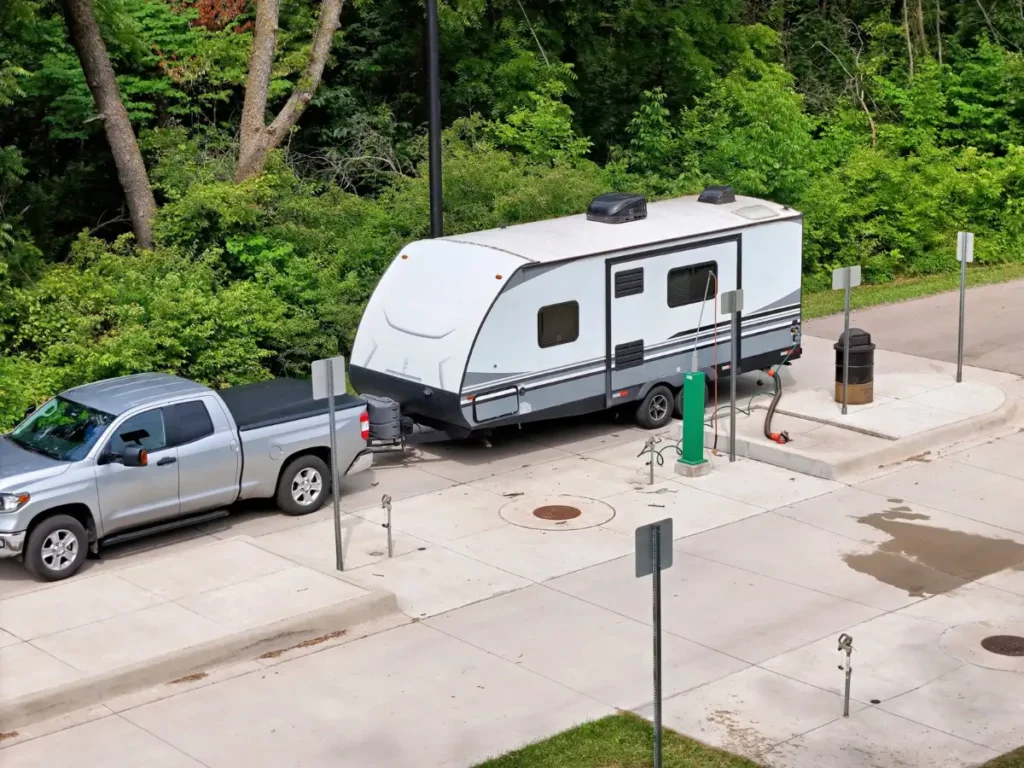
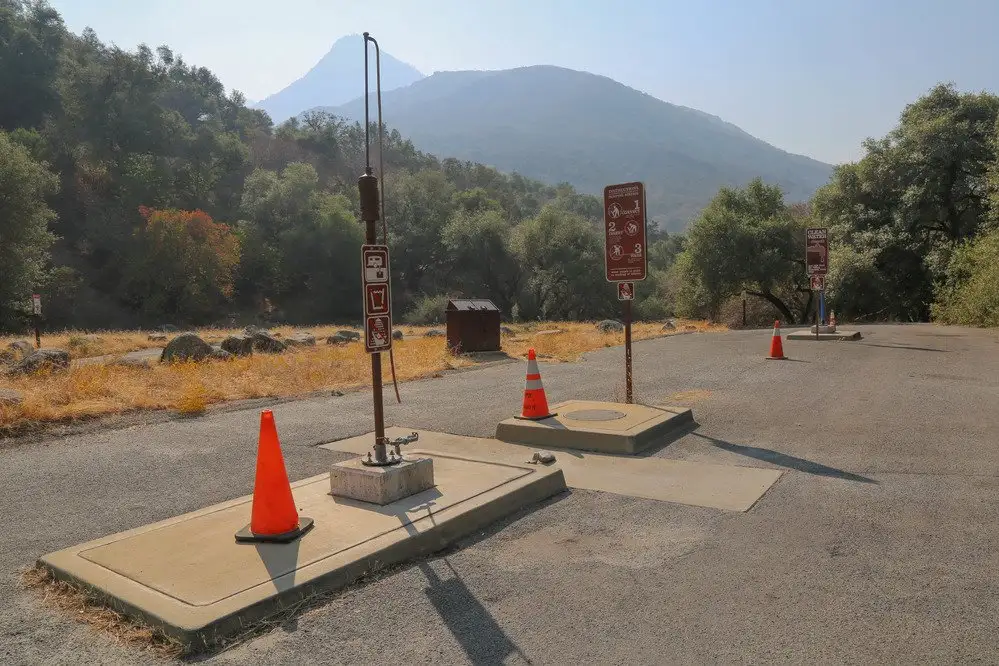
- Does your campground’s official record list a dump station? If yes, note whether it is described as seasonal and plan to arrive with headroom rather than depending on immediate access.
- If no, where is the nearest legal facility on your route? Identify it before departure from official campground or agency pages, and put it on the itinerary as a stop, not a hope.
- Is your travel window at the season’s edge? A listed facility is not necessarily an operating facility. Lewis Lake’s own record conflicts between October 1 and September 30 and warns water may shut earlier, so use September 30 as the conservative outer date and re-verify close to travel.
- Are you on federal recreation land? In National Park System units, draining refuse from a trailer or vehicle anywhere except facilities provided for that purpose is prohibited under 36 CFR 2.14; National Forest regulations require wastewater disposal at provided facilities or removal from the site under 36 CFR 261.11. Rules on state, county, and private land are set by those jurisdictions — verify locally rather than assuming any of this transfers.
- What’s the fallback? Name the second dump option before you need it. If the answer is “there isn’t one,” your consumption plan carries the whole trip.
Failure modes worth planning against
- The seasonal shutoff surprise: arriving at a primitive campground in the shoulder season with a quarter tank of fresh, assuming the spigot works. The official record’s service window is the planning document; the tap is not.
- The full-arrival mistake: pulling into a no-dump campground with waste tanks already half full from the last trip. Every framework above assumes you arrive empty-waste, full-fresh; departure-day prep is where trips are actually won.
- Full hookups treated as infallible: hookups reduce the need to schedule separate service stops, but site services can be interrupted — Yellowstone’s Fishing Bridge operator, for example, has published advisories about limited electric supply and possible temporary outages on hot days (operator alerts page). Verify services at check-in and keep tank headroom even when connected.
- The gray-tank shower spiral: daily onboard showers can make gray capacity bind earlier than expected. Decide the shower cadence before the trip, not at the gauge.
- One-facility dependence: a route where a single dump station carries the whole plan has no failure tolerance. Build the fallback in step 5 above every time.
Water and waste equipment
The calculation, more than any hardware, is what keeps you from running out; the gear below supports the plan but does not replace it. These links open Amazon search results by equipment class so you can match hose lengths, fittings and capacities to your own rig.
- Sewer hose kits and fittings
- Drinking-water safe fresh hoses
- Water pressure regulators
- Portable waste tanks
- Holding tank treatments
- Tank rinse wands and clear elbows
These are affiliate links.
Sanitation and safety notes
- Use designated facilities, full stop. The federal regulations linked above prohibit draining tanks outside provided facilities on NPS and National Forest land, and 36 CFR 2.14 also prohibits washing dishes or property at public water outlets not designated for it, and polluting park waters.
- Separate your hoses. Keep a dedicated drinking-water hose that never touches dump-station duty, stored apart from sewer equipment. This is standard practice guidance, not a cited regulation.
- Fill fresh water only at designated potable points. Rinse hoses at dump stations exist to clean sewer fittings; treating one as a drinking-water source defeats the entire separation. Where a record distinguishes a “potable water filling station” — as Colter Bay’s does — that’s the fill point.
- Gloves and hand-washing at every dump. Basic hygiene practice; no regulation needed to justify it.
- Chemicals: use products intended for RV holding tanks and follow their labels; NPS regulations prohibit depositing refuse into toilet-facility plumbing and vaults, which includes improvising disposal of tank contents or chemicals there.
Print this guide: pre-trip services checklist
- Write down your three tank capacities and compute usable fresh (rated minus 10 percent).
- Run the planning-day framework for your crew; note the earliest conservative limit across fresh, estimated gray, and observed black accumulation.
- Pull the official record for each campground on the itinerary; record its service level and any stated seasonal windows.
- Mark every planned dump and potable fill point on the route, plus one fallback for each.
- Confirm your travel dates sit inside any stated water-service windows; re-verify the week of travel.
- Depart with waste tanks empty and fresh tank full (or full enough for leg one plus buffer).
- Pack the separated hose kit: drinking-water hose, sewer kit, gloves, stored apart.
- Set the shower cadence with the crew before night one.
- At check-in, verify the site’s services match the record before fully setting up.
- Keep the 20 percent buffer sacred — it’s the plan’s only shock absorber.
This framework pairs with the site-level fit method in our guide to reading campground length limits, the park records in the campground finder, and the route templates in weekend RV trips. If your dry-camping plan leans on battery power, the RV solar setup decision guide covers the electrical side; fuel stops for service runs belong in the RV trip fuel calculator.
Frequently asked questions
Which RV tank runs out first?
Whichever one reaches its planning limit first — fresh, gray or black. It depends on the rig and on behavior rather than on a rule: gray water is a common risk on shower-heavy trips, but it is not a universal default. Run the numbers for your own capacities instead of assuming the tank that binds on someone else’s trip will bind on yours.
How much water does an RV use per person per day?
The planning figures used in this guide are 1.5 gallons per person per day for drinking and cooking, 2.5 gallons per crew per day for dishes washed conservatively with the basin method, 4 gallons for a navy shower, and 0.75 gallons per person per day for toilet flushing. Keep 20 percent of every tank in reserve for delays, spills, and the day the dump station you counted on is closed.
Where can I legally empty RV tanks?
Use designated facilities. In National Park System units, liquid waste from a trailer or vehicle must go to a facility provided for that purpose. On National Forest System lands, sewage and wastewater must be removed from the site or placed where the agency provides. 36 CFR 2.14 additionally prohibits washing dishes or property at public water outlets not designated for it, and prohibits polluting park waters.
How much of the fresh tank can I actually use?
For conservative planning this guide treats 90 percent of rated fresh capacity as usable, to allow for pump-pickup uncertainty and water the system may not deliver. That is an editorial convention rather than a manufacturer specification, and it sits on top of the 20 percent reserve, so plan the trip on the smaller number.
Methodology, limitations, and how to correct us
This guide reflects official sources as they read on August 2, 2026. The consumption figures, the 90 percent usable-fresh convention, and the 20 percent trip buffer are conservative Ticheka planning assumptions, not agency or manufacturer standards. The worked examples are calculations, not field tests. Black-tank capacity cannot be derived from flush water alone and must be checked against the owner’s observed trend. Facility characteristics cited here are volatile; Lewis Lake’s official page contains conflicting water dates, so this guide uses the earlier date and requires re-verification. We make no claim about live facility status, no single nationwide disposal rule, and no statements about state, county, or private-land rules, which vary by jurisdiction. We did not physically inspect any facility.
If you find an error, or an official source has changed since our fact-check date, tell us and we will correct the article and log the change per our editorial policy and corrections policy. Our sourcing standard is documented on the data sources and methodology page.
Sources
- eCFR — 36 CFR 2.14, sanitation and refuse in park areas
- eCFR — 36 CFR 261.11, sanitation on National Forest System lands
- National Park Service — Colter Bay RV Park
- National Park Service — Yellowstone campgrounds
- Grand Teton Lodge Company — Colter Bay Campground
- Recreation.gov — Colter Bay RV Park record
- Recreation.gov — Colter Bay Campground record
- Yellowstone National Park Lodges — Operator alerts
- Ticheka — Data sources and methodology