
 Skip to content
National Park RV Planning
National Parks RV Camping Hub
Plan around exact campsite fit, booking windows, dry-camping limits, and road restrictions—not a campground’s headline maximum.
Quick answer
National park RV camping is governed by three things that have nothing to do with scenery: whether your rig physically fits, whether the campground has hookups (usually it does not), and whether you were online at the exact minute the reservation window opened. Get those right and the rest of the trip is straightforward. Get any one wrong and no amount of flexibility later recovers it.
This hub covers how park camping works as a system, then routes you into the specific tools and guides for each decision.
Three facts that shape every park trip
Hookups are the exception. Most National Park Service campgrounds have no electric, water or sewer at the site. Some parks have exactly one hookup campground; many have none at all. Plan the trip as dry camping and treat any hookup you find as a bonus.
Length limits are real and enforced. Park campground loops were largely cut decades ago for shorter rigs, and the posted limits reflect what the pavement can physically accommodate. On some roads the limit applies to the road itself, not just the campground.
Getting the booking window right decides the trip. Recreation.gov states that most campsites can be booked six months before arrival, that popular campgrounds can fill in minutes, and that some locations use shorter windows alongside the standard one. Your planning calendar is therefore anchored to release dates, not travel dates.
How national park camping reservations work
There are three patterns, and confusing them is the most common way to lose a site.
Rolling six-month release
A new arrival date opens each day, six months ahead, at a specified time. If you want to arrive July 15, you book on January 15. The window is keyed to your arrival date — counting back from departure puts you a day off, which is enough.
Block release
Some campgrounds release a full month of dates at once on a fixed calendar day. These are the ones where “be logged in and refreshing” is genuinely the whole strategy. The campground detail page states which rule applies and in which time zone; read it before setting an alarm.
Concessioner-operated bookings
Not every park campground is on Recreation.gov. Several large parks contract campgrounds to a concessioner with its own reservation system and its own window. Yellowstone is the clearest current example, and it is mid-transition — see below.
Our guide to when national park campsites open for booking tracks which pattern applies where, and how far ahead to set reminders.
Rig fit: the constraint most people discover too late
Reservation systems ask for a combined length — your vehicle plus anything towed, fully extended. That number, not the brochure figure, is what determines which sites are even shown to you. Width limits typically include mirrors, and height limits include roof-mounted equipment, which matters more now that solar arrays and satellite dishes are common additions.
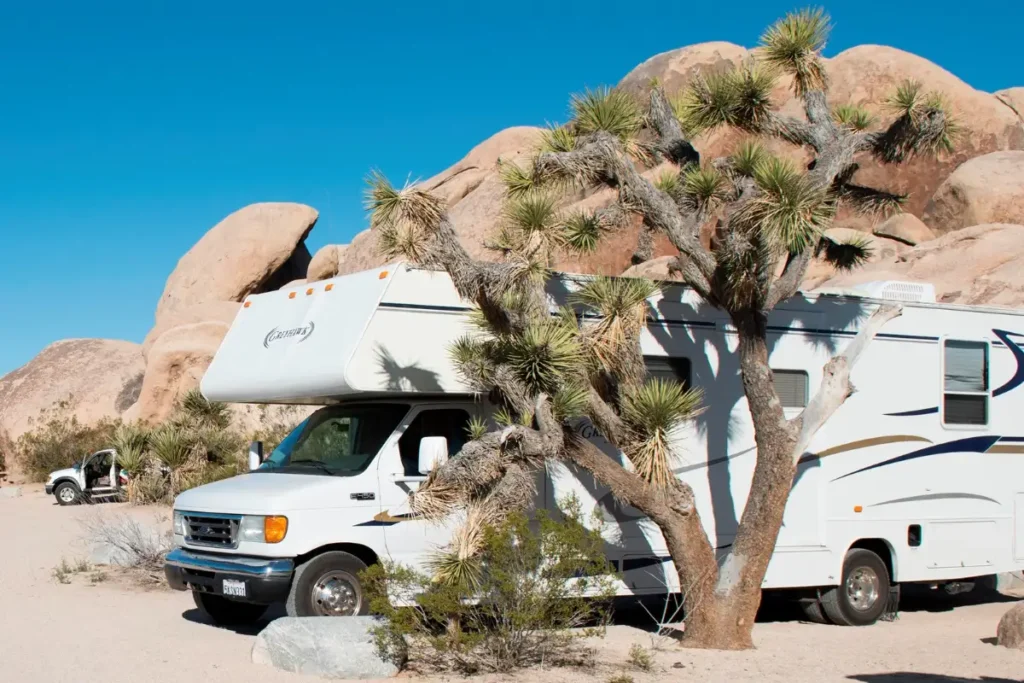
Measure once, properly, and keep the figures where you can read them during a timed booking. The rig measurement guide covers exactly which measurements reservation systems are asking for and where people routinely under-report.
| Combined length | Yellowstone | Glacier | Practical implication |
|---|---|---|---|
| Under 21 ft | Access to essentially all campgrounds, including the smallest first-come loops | Eligible for the full length of Going-to-the-Sun Road and the small lakeside campgrounds | Maximum inventory; you can plan around scenery rather than around fit |
| 21–35 ft | Most campgrounds available; the smallest loops drop out | Excluded from the restricted middle section of Going-to-the-Sun Road; several campgrounds still workable | Plan to park the rig and use shuttles or tours for restricted roads |
| 36–45 ft | Limited to the larger campgrounds; NPS notes that sites accommodating 40 ft or more are limited | Very few in-park options; gateway-town private parks become the base | Book earliest, and expect to day-trip in a smaller vehicle |
| Over 45 ft | Realistically the full-hookup RV park or outside the park | Outside the park | Treat the park as a destination you drive to, not sleep in |
Yellowstone RV camping
Yellowstone is the clearest illustration of the hookup rule. Fishing Bridge RV Park is the only campground in the park offering water, sewer and electrical hookups; every other campground is dry camping. Because the area is frequented by grizzly bears, Fishing Bridge is restricted to hard-sided units — no tents or tent campers. The National Park Service also notes that sites able to accommodate a combined length of 40 feet or more are limited, and that most campsites in Yellowstone will not accommodate oversized units.
Reservations are currently split. Five campgrounds are operated by the park concessioner and booked through its own system; the remainder are booked through Recreation.gov. The concessioner has announced that beginning with the 2027 summer season, Bridge Bay, Canyon, Grant, Madison and Fishing Bridge RV Park will move to Recreation.gov, opening approximately six months in advance. If you are planning across that boundary, confirm which system applies to your dates before you build a reminder schedule.
Generator rules also vary by campground within the park — generator use is prohibited entirely at several of the smaller campgrounds, and where permitted it is time-limited with a decibel cap. If your power plan depends on running a generator, verify the rule for the specific campground rather than the park.
For multi-night dry stays, work backward from tank capacity and battery capacity: see the water tanks and dump stations guide and the RV solar setup guide.
Glacier National Park campgrounds
Glacier’s binding constraint is the road, not the campground. Vehicles and vehicle combinations longer than 21 feet or wider than 8 feet including mirrors are prohibited on Going-to-the-Sun Road between Avalanche Campground and the Sun Point/Rising Sun area — the most scenic middle section. The Park Service also warns that vehicles over 10 feet in height may have difficulty traveling west from Logan Pass because of rock overhangs.
In practice this means anything larger than a small Class B or compact Class C gets driven to one end of the road and left there. The workable pattern for larger rigs is to base at a campground or gateway-town park at one end and use the free park shuttle or a bus tour for the restricted section.
In-park campgrounds do not have hookups. Some Glacier campgrounds combine a six-month booking window with a short-notice window for a portion of sites, which gives late planners a genuine second chance — check the individual campground page rather than assuming the park-wide rule.
Where dispersed camping fits — and where it doesn’t
Dispersed camping is one of the highest-volume camping searches in the United States, and a large share of that traffic is people hoping to find it inside national parks. It is not there. National Park Service camping is in designated campgrounds.
What does exist is dispersed camping on Bureau of Land Management and national forest land that surrounds many parks. BLM guidance states that dispersed camping is generally limited to 14 days within any 28-day period, with limits varying by state and field office, and that after reaching the limit visitors must relocate — often 25 to 30 miles away. Forest Service districts apply similar structures with different specifics, and many forests restrict how far off a numbered road you may drive to reach a site.
Used deliberately, that adjacent land is the pressure valve for park trips: it absorbs the nights when park inventory is gone. Used casually, it is where people get citations. Read the boondocking rules for BLM and national forest land before you rely on it.
Building a backup plan that survives a failed booking
- Identify the one night that cannot move. Everything else is negotiable, so spend your booking attention there.
- Have a second and third campground chosen before the window opens. Not a vague “somewhere else” — specific sites you have already confirmed fit your length.
- Set cancellation alerts. High-demand sites turn over steadily as speculative bookings unwind closer to the date.
- Pre-scout one legal dispersed area within reasonable driving distance. Confirm the road is suitable for your rig before you need it in the dark.
- Check conditions before departure. Fire restrictions, road status and closures move late in the season. National park alerts covers what to watch.
- Filter, don’t browse. The campground finder narrows by length and hookup type first, which is the fastest way to build a shortlist that is actually bookable.
Broader trip sequencing — routing, fuel costing, packing — is covered in the RV camping planning hub and the RV camping checklist. If you plan to work from the road between park stops, note that in-park cell coverage is unreliable by design; the RV internet setup guide covers the realistic options.
Print this guide
This guide prints cleanly from any browser — no plugin, no download, no sign-up. Navigation, images and site links are hidden automatically in the printed version.
Frequently asked questions
Which national parks have full-hookup RV sites?
Very few, and the answer changes by park rather than by rule. Yellowstone has exactly one such campground. Many parks have none, and the nearest full hookups are in gateway towns outside the boundary. Check the specific park’s camping page rather than assuming.
How far in advance should I book?
For competitive summer sites, plan to book at the moment the window opens — commonly six months before arrival, though some campgrounds use block releases or shorter windows. Set the reminder for the release date and confirm the time zone on the campground page.
Can I show up without a reservation?
Sometimes, at first-come campgrounds, and the odds are much better midweek and early in the day than on a Friday afternoon in July. Several parks have also converted formerly first-come campgrounds to reservation-only, so verify current status for the specific campground and season.
Is dispersed camping allowed just outside park boundaries?
Often, on BLM or national forest land, subject to that unit’s rules, stay limits, road restrictions and any active fire or occupancy orders. It is not automatic, and posted local orders override general guidance.
My rig is 38 feet. Should I skip Glacier?
No — you should skip driving the restricted middle section of Going-to-the-Sun Road. Base outside or at an end-of-road campground that fits you, and use the shuttle or a bus tour for the section your rig cannot legally travel.
Sources
- National Park Service — Yellowstone campgrounds
- National Park Service — Glacier camping
- National Park Service — Going-to-the-Sun Road vehicle restrictions
- Recreation.gov — Reservation timing guidance
- Bureau of Land Management — Camping on Public Lands
Campground operators, booking systems, seasons and vehicle restrictions change between seasons. Verify against the park’s official page for your travel dates. Our sourcing approach is described in data sources and methodology.