
 Skip to content
Great Smoky Mountains National Park
Great Smoky Mountains RV Camping Guide
Choose the right side of the park, verify the exact campsite record, and avoid the parking-tag and road rules that surprise first-time RV visitors.
Quick answer
Start here: every campground inside Great Smoky Mountains National Park is dry camping. There are no electric, water or sewer hookups and no showers at the park’s frontcountry campgrounds. Reservations are required, and the campground you choose is really a choice of which side of the mountain you will spend the weekend on — Tennessee or North Carolina — because crossing between them eats hours you do not have on a short trip. Beyond that, three things decide whether the trip works: the exact campsite record’s pad and equipment limits, the roads your rig is banned from, and a parking tag rule that surprises almost every first-time RV visitor.
What the Smokies offers an RV
The National Park Service maintains developed frontcountry campgrounds at ten locations. Cades Cove and Smokemont are open year-round; the rest are seasonal. Every campground has restrooms with cold running water and flush toilets, and every site has a fire grate and picnic table. That is the amenity list.
What is not on it matters more. There are no showers and no standard electric, water or sewer hookups anywhere inside the park. A small number of sites at Cades Cove, Elkmont and Smokemont are described as carrying low-amperage outlets reserved for documented medical equipment such as CPAP machines; these are limited and are not recreational hookups, so confirm the site record and the requirement with the campground before relying on one. Dump and fresh-water stations exist but are not always at the campground — the Elkmont record states its dump and fresh-water filling station sits six miles east.
Plan the whole stay on battery, tank and propane. Our RV camping checklist covers the power, fresh-water and gray-tank math for a two- to four-night stay without service.
The parking tag rule that catches RV campers
The Smokies charges no entrance fee. It does require a parking tag for any vehicle parked longer than 15 minutes anywhere inside park boundaries. Three durations are sold: daily $5, weekly $15, annual $40.
The details that trip people up:
- Tags are per vehicle and must carry a matching license plate number.
- A physical tag must be displayed. Digital copies are not accepted. Buying online means printing, or picking the tag up on arrival.
- An America the Beautiful pass — Senior, Access, Military and the rest — does not substitute for a parking tag.
- Tags are not location-specific and do not reserve you a space.
- Frontcountry campers do not need a tag while parked in their own assigned campsite, but they do need one the moment they park anywhere else in the park.
That last point is the one that matters. If you tow a car or drive a motorhome to a trailhead, that vehicle needs its own tag — two vehicles means two tags. Buy ahead or at a tag machine, and note that many trailheads have no machine. Tags are not required on national fee-free days; the 2026 dates are on the park’s fees page.
Pick a side of the mountain, then a campground
Newfound Gap Road is the spine of the park, and crossing it with a rig in summer or leaf season is slow. A Tennessee base and a North Carolina objective will cost most of a day. Decide which side you want, then pick the campground that serves it.
Smokies campground comparison for RV travelers
| Campground | Side and gateway | Season | Why you would pick it | What to check first |
|---|---|---|---|---|
| Cades Cove | Tennessee, west; Townsend gateway | Open year-round | The 11-mile loop, historic structures, wildlife viewing and a camp store in season. Dump station and potable water on site. | Winter loop reductions, and the vehicle-free Wednesday closure of the Loop Road. |
| Elkmont | Tennessee, central; Gatlinburg and Sugarlands | Seasonal | The largest campground in the park, riverside sites, and the shortest reach to Newfound Gap Road and central trailheads. | The dump and fresh-water station is roughly six miles from the campground, so plan tank service into the arrival or departure leg. |
| Smokemont | North Carolina, east; Cherokee and Oconaluftee | Open year-round | The reliable year-round base on the Carolina side, close to Oconaluftee and the Kuwohi approach. | Loop-specific rules — tents are not permitted in Loop F — and reduced off-season office hours. |
| Look Rock | Tennessee, western Foothills Parkway | Seasonal | The exception to the no-hookup rule: a portion of its inventory is listed with hookups. | Inventory is limited and site-specific. Confirm which sites carry service on the live campground record before assuming it. |
Abrams Creek, Balsam Mountain, Big Creek, Cataloochee, Cosby and Deep Creek round out the ten. Several are small, and some are effectively closed to larger rigs by the roads leading to them rather than by the campground itself. To weigh in-park dry camping against a serviced private site outside the boundary, our campground finder compares them on access and equipment fit rather than reviews.
Rig fit: what to read before you pay
There is no single Smokies RV length limit, and quoting one would mislead you. Limits vary by campground, by loop and by pad. Two sites twenty feet apart can produce different outcomes for the same 32-foot trailer.
The Recreation.gov record for each site governs. One Elkmont record reads, in part: the pad is long and level but has an obstruction at the end; the site will take large RVs, tent trailers or tents; generator use is permitted between 8:00 a.m. and 8:00 p.m.; food storage rules are strictly enforced. Four operational facts, only one of them a number — and none visible on a campground map thumbnail.
Before you pay, capture:
- Permitted equipment and the maximum length for your type. RV, trailer, fifth wheel and pickup camper limits are frequently different on the same page.
- Driveway entry, length, surface and grade. Grade is the one most people skip, and it is the one that decides whether you can level in a creekside loop.
- Obstructions and overhead clearance. Smokies pads are cut into mature hardwood forest; low limbs are common.
- Generator hours for that site or loop. They are not uniform across a campground, and at Cades Cove they shift seasonally as loops open and close. Group camps prohibit generators outright.
- Maximum vehicles. A towed car counts as a vehicle.
Measure the rig connected, add racks and hitch extensions, and book to the smaller relevant number. When a record is incomplete, call the campground — arriving with equipment that does not fit is not a problem solved at the kiosk.
Roads closed to motorhomes and towed trailers
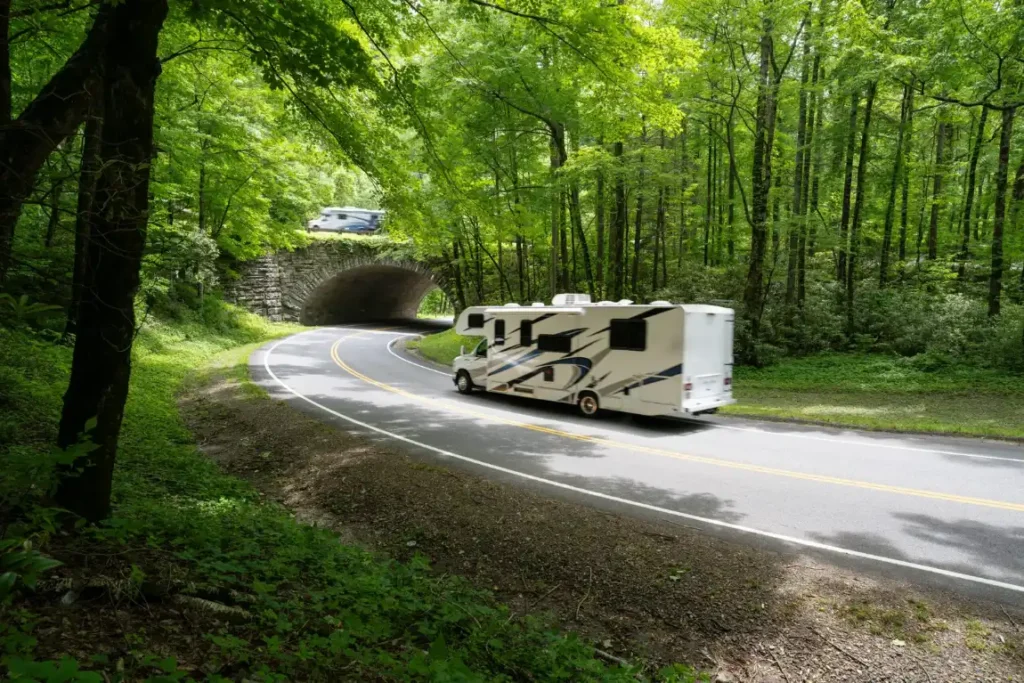
Primary roads — Newfound Gap Road (US 441), Little River Road and the Cades Cove Loop Road — are open year-round, weather permitting. Several of the park’s most scenic secondary roads are not open to you at all if you are driving a motorhome or towing.
The park’s seasonal road schedule lists the following as prohibited to motorhomes, buses and vans longer than 25 feet, plus passenger vehicles towing trailers:
| Road | 2026 season | Character |
|---|---|---|
| Roaring Fork Motor Nature Trail | Apr 17 – Nov 29 | One-way and very steep |
| Rich Mountain Road | Apr 10 – Nov 9 | One-way |
| Parson Branch Road | May 1 – Nov 9 | One-way, 8 miles, high clearance recommended |
| Little Greenbrier Road | Apr 3 – Nov 29 | Access to the Little Greenbrier Schoolhouse |
| Heintooga Ridge Road | May 15 – Oct 31 | Paved, connects the Blue Ridge Parkway |
| Heintooga Round Bottom Road | Dates to be announced | One-way gravel |
| Wear Cove Road | Year-round | Narrow two-way, ten-ton weight limit |
Two more scheduling notes for 2026: Kuwohi Road (formerly Clingmans Dome Road) runs April 1 through November 29 and closes for snow and ice; Straight Fork Road has no announced season, still recovering from Hurricane Helene impacts. And the Cades Cove Loop Road is closed to vehicles each Wednesday, typically May through September — an all-day closure, not a morning one. If you have booked Cades Cove and planned the loop for a Wednesday, move the loop, not the reservation.
If a Carolina-side objective is pulling you across the park, price the round trip first with our RV trip fuel calculator. Mountain grades and a towed load change the number more than mileage alone suggests.
Booking, check-in and the no-show rule
Frontcountry, group and horse campsites all require advance reservations through Recreation.gov, generally up to six months ahead. Group sites open further out.
Arrival procedure is stricter than the relaxed atmosphere suggests. Campgrounds are not gated, so late arrival is fine, but you must check in with office staff. At Smokemont, failing to check in by noon the day after arrival is treated as a no-show and can forfeit the reservation. From November through April, when offices open only intermittently, campers must be able to show proof of occupancy on request. Quiet hours are 10:00 p.m. to 6:00 a.m. park-wide.
A three-night plan that avoids a wasted transfer day
Built for a Tennessee base at Elkmont or Cades Cove, one towed vehicle, and no ambition to see both states.
Day one — arrive, service, settle
Provision and fuel in the gateway town, not inside the park. Buy certified heat-treated firewood on the way in or at the campground concession. If your base is Elkmont, handle the dump and fresh-water stop on the approach leg while you are already hitched, rather than losing an hour mid-trip. Park, buy tags for every vehicle you will move, and store food before unpacking anything else.
Day two — one corridor, on foot
Leave the rig on the site and use the towed vehicle. Pick one corridor — the Little River and Elkmont trailheads, or the Cades Cove loop and its historic structures — and stay in it. Start early: popular trailhead lots fill long before mid-morning, and a tag does not hold you a space.
Day three — the flexible day
Use what the conditions page tells you. A scenic drive open to a passenger car may be closed to you the moment you re-hitch, so check the restricted-road list against whatever you plan to drive. A Wednesday in season means the Cades Cove loop is bikes and boots only — a feature, if you planned for it.
Departure morning — verify in order
Conditions page first, then your site and campground record, then the route. Confirm fuel, fresh water, gray and black capacity, and that food and scented items are secured until the moment you pull out.
Bears, firewood and generators
These are enforced rules with fines attached, not campground etiquette.
Food storage. All food, drinks and food-preparation equipment — pots, dishes, hard coolers — must be kept in a sealed vehicle or a camping unit of solid, non-pliable material whenever not in use. Scented items and water containers must be stored too. A soft-sided pop-up is not a storage container. Improperly stored items may be impounded.
Firewood. Only heat-treated firewood in its original packaging, bearing a USDA or state agriculture certification seal, may be brought into the park. You may also collect dead and down wood inside the park. Seasonal on-site sales operate at Cades Cove Campground Store, Elkmont, and Smokemont Riding Stables.
Generators. Hours are set by site and loop and appear on the site record. Group camps prohibit generator use entirely. At Cades Cove, generator permissions shift between loops as sections close for the season. Do not rely on the general campground description when the site record carries a stricter rule.
Checking conditions before you roll
The Smokies runs a live cautions-and-closures page separate from its seasonal schedule, and that is the one catching tree work, storm damage, water-system outages and temporary loop closures. Check it a week out and again on departure morning, alongside the campground record and an elevation-aware forecast — clear conditions in Gatlinburg tell you little about Newfound Gap.
Our national park alert check consolidates the official feeds if you would rather review them in one place.
Print this guide
This guide prints cleanly from any browser — no plugin, no download, no sign-up. Navigation, images and site links are hidden automatically in the printed version.
Frequently asked questions
Are there any RV hookups in Great Smoky Mountains National Park?
Not at the main frontcountry campgrounds. Look Rock lists hookups on part of its inventory; everything else is dry camping. A few sites at Cades Cove, Elkmont and Smokemont carry low-amperage outlets designated for medical equipment, which are not general-purpose hookups.
Which Smokies campgrounds are open in winter?
Cades Cove and Smokemont are listed as open year-round. All others are seasonal, and some loops within the year-round campgrounds close in the off-season.
Do I need a parking pass if I am camping?
Not while your vehicle is in your assigned campsite. Yes, for any vehicle parked anywhere else in the park for more than 15 minutes — including a trailhead lot. The tag must be a physical tag with your plate number on it.
What is the maximum RV length in the Smokies?
There is no single park-wide number. Limits are set per campsite and appear on that site’s Recreation.gov record, along with driveway length, grade and obstruction notes. Book against your equipment type’s number.
Can I drive Roaring Fork or Rich Mountain Road with my trailer?
No. Both prohibit motorhomes, buses and vans longer than 25 feet as well as passenger vehicles towing trailers. Drop the trailer at your campsite and drive them in the tow vehicle alone, or skip them.
Sources
- Frontcountry camping — campground list, amenities, year-round versus seasonal
- Fees and passes — parking tag rules, prices and fee-free days
- Seasonal road schedule — 2026 dates and vehicle-size prohibitions
- Cades Cove vehicle-free days
- Current cautions and closures
- Park alerts and conditions
- Firewood regulations
- Park and campground maps
- Cades Cove Campground on Recreation.gov
- Smokemont Campground on Recreation.gov
- Daily and weekly parking tags on Recreation.gov
Operating dates, fees, site dimensions, service levels and closures change during a season. Figures here come from the linked federal sources as of the date shown in the page byline; where a site-level detail could not be confirmed, we have directed you to the live record rather than estimating it. The linked authority governs. Our data sources and methodology page explains how these checks are made and corrected.
Make the final approach part of the campsite decision
Two sites in the same campground can create different outcomes for a long trailer. Save the site-specific equipment allowance, driveway entry, surface, grade, overhead notes, and generator rule before paying. Then compare the final approach with the measured height and complete connected length. If the evidence is incomplete, choose a more conservative site or contact the campground rather than relying on a map thumbnail.
Protect the short-trip schedule
- Choose one gateway: a Tennessee and North Carolina combination can turn a weekend into a transfer day.
- Arrive with service margins: carry the power, water, and tank plan for a no-hookup stay unless the exact reservation says otherwise.
- Keep wildlife storage operational: assign a sealed storage location before arrival so food and scented items are not left outside while unloading.
- Match generator use to the reserved loop: do not rely on a general campground description when the site record contains a stricter rule.
- Check the route again: weather, traffic, closures, and incidents can change a mountain approach after the reservation is made.
Departure-day verification order
Open current conditions first, then the campground record, then the route. Confirm that the site and departure road still fit the complete rig; verify fuel, fresh water, wastewater capacity, and food storage; and keep the official pages available offline. This order prevents an attractive activity plan from hiding a more important access or equipment problem.
Visual sources: NPS public-domain photographs plus a Ticheka-produced illustrative video. The video is planning context, not footage of a Ticheka field test.