
 Skip to content
RV Trip Planning
RV Camping Planning Hub
A practical sequence for matching your rig, reservation window, service needs, route, and budget before the trip becomes expensive.
Quick answer
The fastest way to plan an RV trip is to settle four constraints before you look at a single campground: your rig’s true measured length, which nights are fixed, whether you need hookups, and how far you are willing to drive between stops. Reservations, boondocking, budget and route all fall out of those four answers. Most trips that go wrong go wrong because someone booked scenery first and checked the numbers second.
This hub is the routing layer for RV trip planning on Ticheka. It explains the sequence, then hands you off to the tool or guide that does the actual work at each step.

The four constraints that decide your trip
Treat these as inputs, not preferences. Each one eliminates options before you spend time on them.
1. Measured length, width and height
Not the brochure length. Campground limits are usually stated as a combined figure — tow vehicle plus trailer, or motorhome plus towed car — and the number that matters is bumper to bumper with everything hitched and extended. Width limits normally include mirrors; height limits include anything mounted on the roof, which is where solar arrays and satellite hardware quietly change your clearance. Our guide to measuring your RV for campground limits walks through the measurement that reservation systems are actually asking for.
2. Fixed nights versus flexible nights
Separate your itinerary into nights that cannot move (a park you flew people in for, a wedding, a ferry) and nights that can. Fixed nights get booked first, at the earliest possible moment. Flexible nights absorb the risk when a booking fails.
3. Hookup dependence
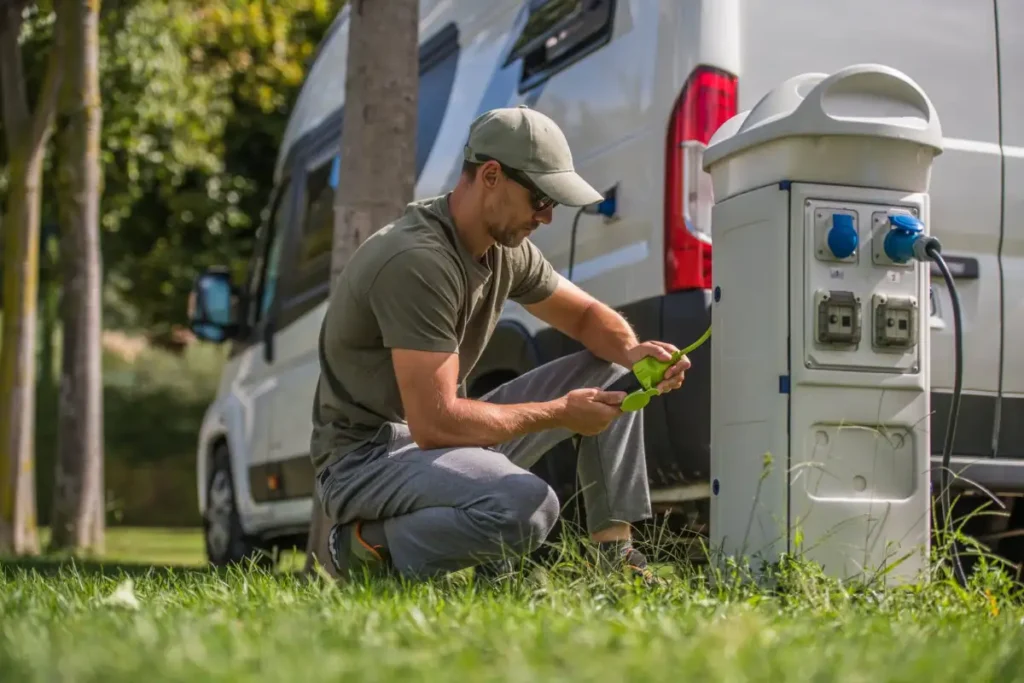
Be honest about whether you need shore power or only prefer it. A CPAP, a medical refrigerator, or a residential-style fridge with no propane mode makes power a hard requirement. If it is a preference rather than a requirement, dry sites open up dramatically more inventory — see the RV solar setup guide for how to work out whether your battery bank can actually cover a night off-grid. Connectivity deserves the same honest audit: if you have to stay reachable or keep working from the rig, sort out planning an RV internet setup before you commit to remote sites.
4. Daily driving tolerance
Pick a number in miles or hours and defend it. Long transit days are where fuel burn, fatigue and arrival-after-dark problems compound. The RV trip fuel calculator converts a candidate route into an estimated fuel cost so the tradeoff between two routings is a number instead of an argument.
Which type of RV camping fits
Four broad categories cover almost every night you will spend in a rig. Most good trips mix at least two. If you are still working out which mix suits your rig, planning a weekend RV trip is the cheapest way to test two of them back to back.
| Factor | Developed public campground | Private RV park | Dispersed / boondocking | Overnight transit stop |
|---|---|---|---|---|
| Hookups | Often none; sometimes electric only | Typically full: power, water, sewer | None | None |
| How you get a site | Reservation window or first-come | Direct booking, usually open further ahead | Self-selected, first-come | Property permission, varies nightly |
| Cost pressure | Low to moderate | Highest per night | Usually free | Free to low |
| Binding constraint | Site length and availability | Price and highway noise | Access road quality; stay limits | Whether overnight parking is permitted at all |
| Best used for | Nights near the thing you came to see | Resets: laundry, tanks, full recharge | Cost control and solitude | Covering distance between destinations |
| Typical failure | Sold out the day the window opened | Budget creep across a long trip | Turning around on a road your rig cannot use | Arriving to a posted no-overnight sign |
The planning sequence, in order
- Measure the rig. Write the combined length, width with mirrors, and height with roof equipment somewhere you can read it while booking.
- Fix the anchors. Identify the nights that cannot move and the parks or areas they depend on.
- Check booking windows before dates. For federal campgrounds the release date, not the trip date, is what you plan around. See when national park campsites open for booking.
- Build the skeleton route. Anchors first, then transit nights between them, then the flexible nights.
- Search inventory. Use the campground finder to filter by the length and hookup constraints you just wrote down rather than browsing by photograph.
- Cost the route. Run the fuel calculator on your skeleton. If the number surprises you, cut mileage before cutting nights.
- Plan water and waste. Fresh capacity, gray and black capacity, and where you will dump determine how many consecutive dry nights are realistic. Start with the RV water tanks and dump stations guide.
- Pack against a list, not memory. The RV camping checklist exists so the departure morning is boring.
- Set alerts and re-check conditions. Closures, fire restrictions and road status change late. National park alerts covers the units where this matters most.
“RV camping near me” and “free camping near me,” done properly
Both searches are enormously popular and both return a mix of genuinely useful listings and directory pages that have never verified a site. Two habits fix most of it.
Filter before you browse. A campground that looks perfect and cannot take your length is a wasted twenty minutes. Length, hookup type and season are the filters that eliminate the most bad results fastest.
Confirm the land manager, not the aggregator. “Free camping” on public land is not a blanket permission. The Bureau of Land Management states that dispersed camping is generally limited to 14 days within any 28-day period, with specific limits varying by state and field office, and that after reaching the limit visitors must move — often 25 to 30 miles away. Forest Service districts run comparable but not identical rules, and many forests restrict how far off a numbered road you may drive to reach a site. Our boondocking rules for BLM and national forest land guide covers how to check the specific district before you commit an evening to finding a site.
Inside National Park Service units, the answer is simpler: camping is in designated campgrounds. Dispersed camping is not a national park option, which is why park nights need the reservation discipline described in the national parks RV camping hub.
A realistic planning timeline
Recreation.gov advises that most campsites can be booked six months before the arrival date and that popular campgrounds can fill in minutes, with some locations offering shorter windows alongside the standard six-month one. That single fact sets the shape of the calendar.
| Timing | Task | Why then |
|---|---|---|
| 7+ months out | Measure rig; confirm each campground’s release rule | Rules vary by site; rolling and block releases behave differently |
| 6 months out | Book anchor nights the moment the window opens | Competitive sites clear in the first minutes |
| 3–4 months out | Fill transit nights; book private parks for resets | Lower competition, but summer weekends still tighten |
| 1 month out | Cost the route; scout dispersed backups; service the rig | Enough time to change the plan if the numbers are wrong |
| 1–2 weeks out | Re-check closures, fire restrictions and road status | These change on short notice and can invalidate a leg |
| Trip week | Pack to checklist; confirm dump and water points | Removes the most common day-one improvisation |
What actually moves the budget
In practice, three lines dominate: fuel, nightly site cost, and the cost of arriving unprepared. Fuel is the one most people underestimate, because it scales with route shape rather than trip length — two parks 700 miles apart cost far more than two parks 200 miles apart, even for the same number of nights. Site cost is the one most people over-optimize, chasing free nights on a route that adds mileage worth more than the sites saved. The third line is invisible until it appears: a dump station detour, a replacement part bought at a gateway-town markup, a night in a private park because the reservation failed.
Run the fuel calculator on two candidate routes before you argue about campground prices. The mileage decision is usually worth more than the nightly-rate decision.
Print this guide
This guide prints cleanly from any browser — no plugin, no download, no sign-up. Navigation, images and site links are hidden automatically in the printed version.
Frequently asked questions
How far should I drive per day in an RV?
There is no universal number, and anyone quoting one is guessing about your rig and your tolerance. The useful move is to set your own limit before the trip, then treat it as fixed while routing. Fatigue, fuel burn and arriving after dark all get worse together, and the third one is what causes bad backing incidents in unfamiliar campgrounds.
Do I need a paid RV trip planner?
Not to plan a competent trip. Paid planners mainly save time on route-and-stop assembly; they do not solve the two things that break most trips, which are length constraints and booking windows. A free workflow — measure, check windows, filter inventory, cost the route — covers the same ground. Our campground finder and fuel calculator are free to use.
Is free camping really free?
The site itself costs nothing on land where dispersed camping is permitted; the self-sufficiency does not — you supply your own power, water and waste capacity, and stay limits keep you moving.: you are supplying your own power, water and waste capacity, and stay limits force you to move on a schedule set by the managing office. Budget the added mileage and the tank management honestly before treating free nights as savings.
Can I book a national park campsite and a dispersed site as a backup?
You can hold a reservation and separately identify a legal dispersed area as a fallback, and doing so is sensible for trips where one failed booking would strand you. What you cannot do is treat national park land as the fallback — dispersed camping is not available inside National Park Service campgrounds.
What is the single most common planning mistake?
Counting the booking window from the departure date instead of the arrival date. The window opens relative to when you arrive, and being one day off is enough to lose a competitive site.
Sources
- Recreation.gov — Rules and Reservation Policies
- Recreation.gov — Tips for Making Campsite Reservations at Popular Locations
- Bureau of Land Management — Camping on Public Lands
- National Park Service — Camping
Agency rules, stay limits and reservation windows are set locally and change. Confirm details with the managing office before you travel. How we select and verify sources is described in our data sources and methodology page.