
 Skip to content
Editorial note: This guide is desk research based on official National Park Service, Recreation.gov, and authorized concessioner pages, each checked on August 2, 2026. Booking rules are set per facility and change; always confirm the window on your campground’s own official record before planning around it. See our editorial policy and data sources and methodology.
Quick answer
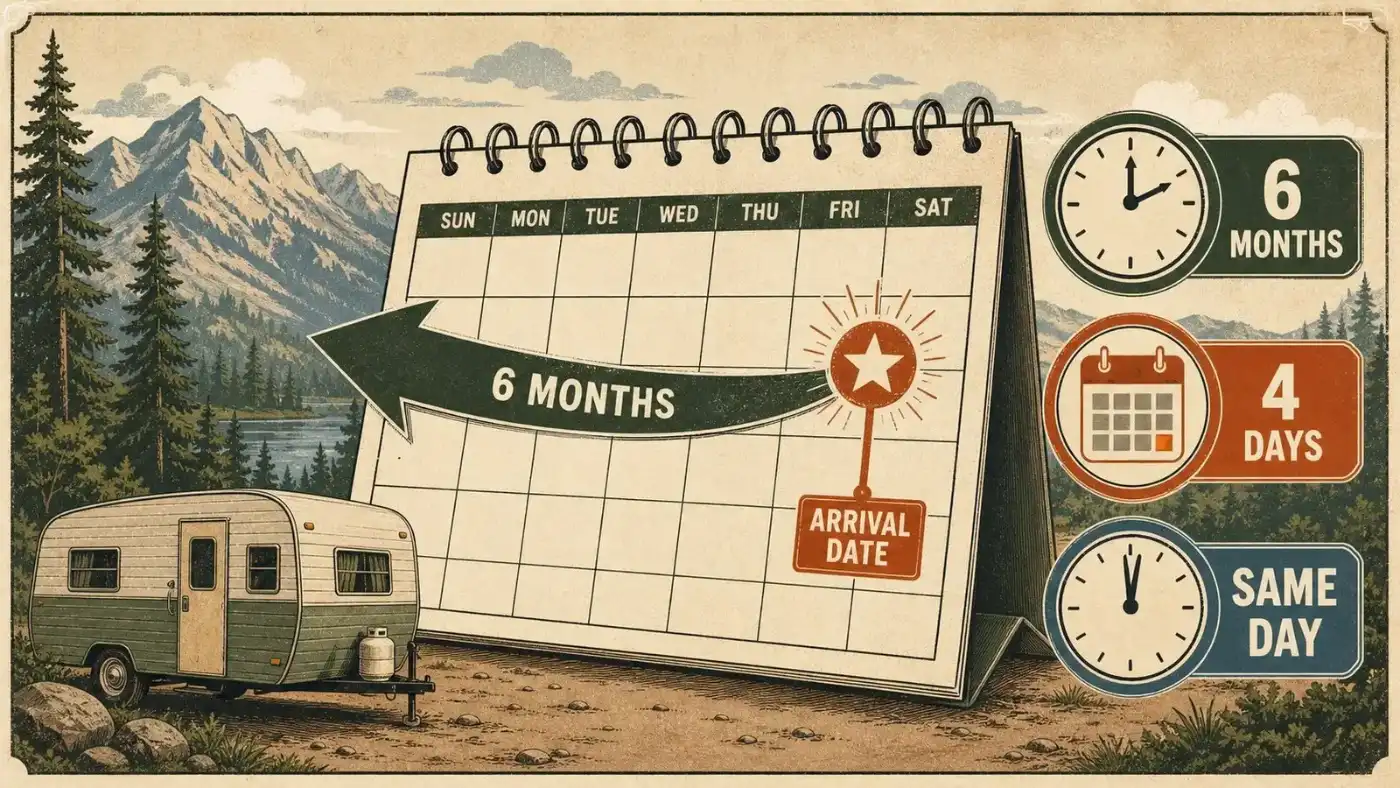
There is no single national rule for when campsites open for booking. On Recreation.gov, most campsites can be booked six months before arrival, but shorter windows and facility-specific exceptions exist (official Recreation.gov booking tips). Official records checked today show six-month rolling windows at Yellowstone and Grand Teton, a mix of six-month and four-day windows inside Apgar Campground, and a day-of window at St. Mary for part of its season. The reliable workflow is to open the campground’s official record, find its stated window, count back from the arrival date, and use any release time the record actually publishes.
How rolling windows work
A rolling window means inventory opens continuously, one day at a time. Grand Teton’s official reservation page states it plainly: camping in the park is reservation-only and bookable on a six-month rolling basis — a June 1 arrival opens December 1 (operator’s official page). Yellowstone’s NPS camping page describes the same rolling six-month structure and notes most sites are reserved far in advance (NPS Yellowstone camping page).
Three practical consequences follow. First, the arrival date is the key date for a multi-night stay. Recreation.gov can allow a reservation to include nights beyond the current booking window, subject to the facility’s rules, availability, maximum-stay limits, and modification restrictions (official reservation policies). Second, clock time can matter: Recreation.gov says most campgrounds open at 7:00 a.m. Pacific, 8:00 a.m. Mountain, or 10:00 a.m. Eastern, but not all do, so use a time only when the facility record or live calendar provides it. Third, each arrival date has an initial on-sale moment, while cancellations and shorter-window inventory can create later opportunities.
Verified examples of how much windows vary
All rows verified on the linked official record, August 2, 2026. These examples show how much windows vary; they are not a directory. Your campground’s record is the authority.
| Facility | Stated booking structure | Official source |
|---|---|---|
| Yellowstone campgrounds (NPS-listed) | All sites reservation-only (one seasonal first-come exception at Mammoth); rolling six-month window | NPS camping page |
| Grand Teton campgrounds | Reservation-only parkwide, six-month rolling window, booked on Recreation.gov only — not through the lodge company’s site or call center | GTLC official page |
| Apgar Campground, Glacier | All sites require reservations; most sites carry a six-month window while a portion carry a four-day window — inside one campground | Recreation.gov record |
| St. Mary Campground, Glacier | For August 17 – September 11, reservations shift to a day-of window; the record does not publish a release time, so confirm the live calendar before relying on an hour | Recreation.gov record |
| Mather Campground, Grand Canyon | Reservations bookable up to six months ahead and recommended March 1 – November 30; the record also notes a limited number of peak-season day-of, first-come sites | Recreation.gov record |
| Yellowstone’s five concession campgrounds | Booked through the park’s lodging concessioner for 2026, with a stated move to Recreation.gov beginning with the 2027 season | operator’s official page |
The Glacier rows are the important lesson: window length can differ within a campground or change during its season. Shorter windows can create near-term booking opportunities. If you plan months out, identify standard-window sites; if you’re booking this week, inspect the facility’s short-window or day-of rules and use a release time only when the official record provides one.
The booking workflow
- Open the official record first. The campground page on Recreation.gov (or the operator’s page, where a concessioner runs booking) states the window. If the text doesn’t state one, the facility’s contact line is the next step — not a guess.
- Count back from arrival. For a six-month window and an August 15 arrival, start with February 15. For month-end dates, use the official calendar’s displayed on-sale date. Put the release time in your calendar only if the facility provides one.
- Prepare the account before the morning. Recreation.gov requires an account; concessioner systems have their own. Grand Teton’s operator page explicitly tells visitors to confirm login credentials before booking day.
- Know your numbers cold. Have your measured rig dimensions ready — the method is in our guide to reading campground length limits — so site filtering takes seconds, not minutes you don’t have.
- Plan multi-night stays from the arrival date. Recreation.gov can allow nights beyond the current window, but verify the facility’s maximum stay, availability, and modification rules before relying on that pattern.
- If you missed the initial window, work the short-window lane. Look for the facility’s stated near-term structure, check periodically for cancellations, and use official alerts where offered.
- Never treat any article — including this one — as availability. Windows tell you when booking opens, not what’s left.
Failure modes
- Starting from the wrong trip date. Recreation.gov guidance is organized around the first reservable date or arrival date, but each facility can set its own rules; confirm the on-sale date shown by its official calendar.
- Assuming one park’s rule at another park. Six months at Yellowstone tells you nothing about a four-day site at Apgar. Per-facility verification is the whole game.
- Missing a platform migration. Booking channels move — Yellowstone’s concession campgrounds shift platforms for 2027 per the operator. Re-check the channel each season, not just the window.
- Time-zone slippage. When an official record publishes a release hour, convert it from the facility’s stated time zone rather than assuming your local time.
- Booking a site the rig doesn’t fit. Speed pressure causes fit mistakes; the measurement card exists so you filter first and click fast second.
Pre-booking checklist
- Official record opened; window noted, plus release time and time zone if the record provides them.
- Booking platform confirmed for the current season (Recreation.gov vs concessioner).
- Account live, login tested, payment method current.
- Rig measurement card at hand; candidate sites pre-filtered where records allow.
- Calendar alarm set from the official on-sale date and, where published, the release time.
- Fallback list written: short-window sites at the same facility, plus one alternate campground from our campground finder.
- Trip framework ready so a booked site becomes a real plan — templates in weekend RV trips and park specifics in the national parks camping hub.
Print this guide
This guide prints cleanly from any browser — no plugin, no download, no sign-up. Navigation, images and site links are hidden automatically in the printed version.
Frequently asked questions
When do national park campsites open for booking?
There is no single national rule. On Recreation.gov most campsites can be booked six months before arrival, but shorter windows and facility-specific exceptions exist. Official records checked for this guide show six-month rolling windows at Yellowstone and Grand Teton, a mix of six-month and four-day windows inside Apgar Campground, and a day-of window at St. Mary for part of its season. Open the campground’s own record and use the window it states.
What does a rolling booking window mean?
It means inventory opens continuously, one day at a time, rather than in a single annual release. Grand Teton’s official reservation page states that camping in the park is reservation-only and bookable on a six-month rolling basis, so a June 1 arrival opens on December 1. Yellowstone’s NPS camping page describes the same six-month rolling structure.
Which date does the booking window count from?
The arrival date. For a multi-night stay, Recreation.gov can allow a reservation to include nights beyond the current window, subject to the facility’s rules, availability, maximum-stay limits and modification restrictions. Counting back from the wrong date is one of the most common reasons a booking attempt fails.
What time do campsite reservations open?
Clock time can matter. Recreation.gov says most campgrounds open at 7:00 a.m. Pacific, but some facilities publish their own release time and some publish none at all. Use the time the official record actually states rather than a time repeated on forums, and be ready a few minutes early.
Limitations, and how to correct us
This guide reflects official records as they read on August 2, 2026. Booking windows, release times, platforms, and policies are all volatile; every example above links to its source and must be re-confirmed there before you rely on it. We make no live-availability claims and no predictions about how quickly any facility sells out. Where a facility’s record does not state a window, we say to ask the facility rather than asserting one. Corrections are welcome under our editorial policy and corrections policy.
Sources
- Recreation.gov — Tips for making campsite reservations
- Recreation.gov — Rules and reservation policies
- National Park Service — Yellowstone camping
- Grand Teton Lodge Company — Camping reservations
- Yellowstone National Park Lodges — Camping
- Recreation.gov — Apgar Campground record
- Recreation.gov — St. Mary Campground record
- Recreation.gov — Mather Campground record
- Ticheka — Data sources and methodology