
 Skip to content
Editorial note: This guide is desk research based on official National Park Service, Recreation.gov, and other U.S. government sources, each checked on August 2, 2026. It does not describe firsthand measuring of any specific rig or site. Length rules are set per campground, per site, and sometimes per road — always confirm the linked official record for your destination before you book. See our editorial policy and data sources and methodology.
Quick answer
The number that decides your reservation is almost never the number in your RV’s brochure. Parks and booking systems use at least five different length definitions — combined length, total vehicle length, per-equipment maximums, driveway length, and road limits that count bumpers and mirrors — and the same rig can pass one and fail another. The reliable approach: measure your rig once, hitched, bumper-to-bumper, including every attachment; record width with mirrors and height to the tallest roof item; then match those numbers against the specific definition on the official record of the site you’re booking, not against a campground’s headline figure. There is no universal national definition, and this article does not claim one — the decoder table below shows what each phrasing means at the park that uses it, with the official source linked inline.
Disclosure: some links in this guide go to Amazon. Ticheka Outdoors is a participant in the Amazon Services LLC Associates Program. As an Amazon Associate I earn from qualifying purchases, at no extra cost to you. Affiliate links never change what we include, how we rank it, or what we say about it. See our affiliate disclosure and editorial policy.
Why “max length” means different things at different parks
Each park unit, concessioner, and booking record describes size limits in its own words, and the differences are material:
- Yellowstone’s official camping table defines its size column as “RV + Vehicle max length” — a combined figure covering your motorhome plus towed car, or tow vehicle plus trailer.
- Lewis Lake’s Recreation.gov record uses “total vehicle length,” states 25 feet, and adds that it is strictly enforced.
- Some Recreation.gov site pages, like this Fort Pickens site at Gulf Islands National Seashore, spell the rule out completely: max vehicle length for a truck pulling a trailer means the total length of the truck and equipment together, and the whole package must fit on the pad with no wheels off the pavement.
- Concessioner-run RV parks can define limits at the site level: Grand Teton’s Colter Bay RV Park describes pull-through sites as holding one RV and one tow vehicle with a maximum total length of 45 feet.
- Roads add their own definitions on top: Glacier’s official 2026 opening announcement prohibits vehicles and vehicle combinations longer than 21 feet including bumpers, or wider than 8 feet including mirrors, on the middle segment of Going-to-the-Sun Road. Zion’s current large-vehicle rules go further by separating single vehicles from combined vehicles and, for combinations, adding a hitch-to-rear-axle limit alongside overall length, width, height, and weight.
The practical consequence: a rig owner who knows only their trailer’s model length is carrying the wrong number for every one of the rules above.
The definition decoder
Each row below quotes the definition style, explains what to compare against it, and links the exact official source where that phrasing appears. All sources checked August 2, 2026; figures are examples of definitions, not a directory of limits — current numbers live on the linked records and on our campground finder.
| Official phrasing | What it counts | What you compare | Park-specific example (official source) |
|---|---|---|---|
| “RV + Vehicle max length” (combined) | Everything you arrive with, connected: motorhome plus towed car, or tow vehicle plus trailer | Your hitched bumper-to-bumper measurement | Yellowstone’s campground table uses this combined definition — e.g., Mammoth is listed at 45 ft May–mid-October and 30 ft in winter, showing the same campground’s limit can change by season (NPS Yellowstone camping page) |
| “Total vehicle length” | The full length of what occupies the site, treated as one total | Your hitched bumper-to-bumper measurement | Lewis Lake, Yellowstone: 25 ft total vehicle length, described as strictly enforced (Recreation.gov Lewis Lake record) |
| “Max vehicle length = truck + equipment package; no wheels off pavement” | Tow vehicle and trailer together, all of it on the pad | Hitched measurement vs the stated driveway figure | Fort Pickens Campground, Gulf Islands National Seashore: the site record states the package definition and the no-wheels-off-pavement rule explicitly (Recreation.gov site record) |
| Per-equipment maximums (“RV max length” / “Trailer max length”) + separate “Driveway Length” and “Site Length” | Each piece of equipment capped separately, with pad geometry listed as additional fields | Your RV-only and trailer-only lengths against the equipment fields, and your hitched length against the driveway field | Elk Creek Campground site A18, Curecanti NRA: RV max 22 ft, trailer max 22 ft, driveway length 36, site length 30, back-in entry (Recreation.gov site record) |
| Concessioner site-level total (“one RV and one tow vehicle, maximum total length”) | The site’s occupancy definition, set by the operator | Hitched measurement vs the site type you book (pull-through vs back-in can carry different totals) | Colter Bay RV Park, Grand Teton: pull-through sites hold one RV plus one tow vehicle, 45 ft total (operator’s official page) |
| Road limit: length “including bumpers,” width “including mirrors” | The rolling dimensions of your vehicle or combination on a restricted road segment | Bumper-to-bumper length and mirror-tip-to-mirror-tip width | Going-to-the-Sun Road, Glacier: combinations over 21 ft long (including bumpers) or 8 ft wide (including mirrors) prohibited between Avalanche Creek and Rising Sun; vehicles over 10 ft tall may have difficulty on one stretch (NPS Glacier 2026 announcement) |
| Route limit with separate single-vehicle and combination tests | Whether a vehicle or hitched combination may use a road corridor at all | Overall length, hitch-to-rear-axle length for combinations, width, height, and loaded weight | Zion–Mt. Carmel Highway: effective June 7, 2026, a single vehicle may not exceed 35 ft 9 in; a combined vehicle may not exceed 50 ft overall and its trailer may not exceed 26 ft from hitch to rear axle. Both categories are limited to 7 ft 10 in wide, 11 ft 4 in high, and 50,000 lb. Zion says measurements include mirrors, tires, air-conditioning units, bike racks, satellite dishes, and other aftermarket attachments (NPS Zion large-vehicle rules; official announcement). Utah DOT publishes affected-route and alternate-route guidance (UDOT Zion-area road restrictions) |
Two patterns worth internalizing from that table. First, campsite limits and road limits are independent tests — passing one says nothing about the other. Second, seasonal and per-site variation means even a correct answer for a campground can be the wrong answer for your dates or your specific site.
How to measure your rig: the protocol
Do this once, carefully, and keep the results where you book from. Every step below is a measuring method, not a park rule.
- Hitch up exactly as you travel. Connect the trailer or towed car, load the bike rack, cargo carrier, and anything else that rides on the outside.
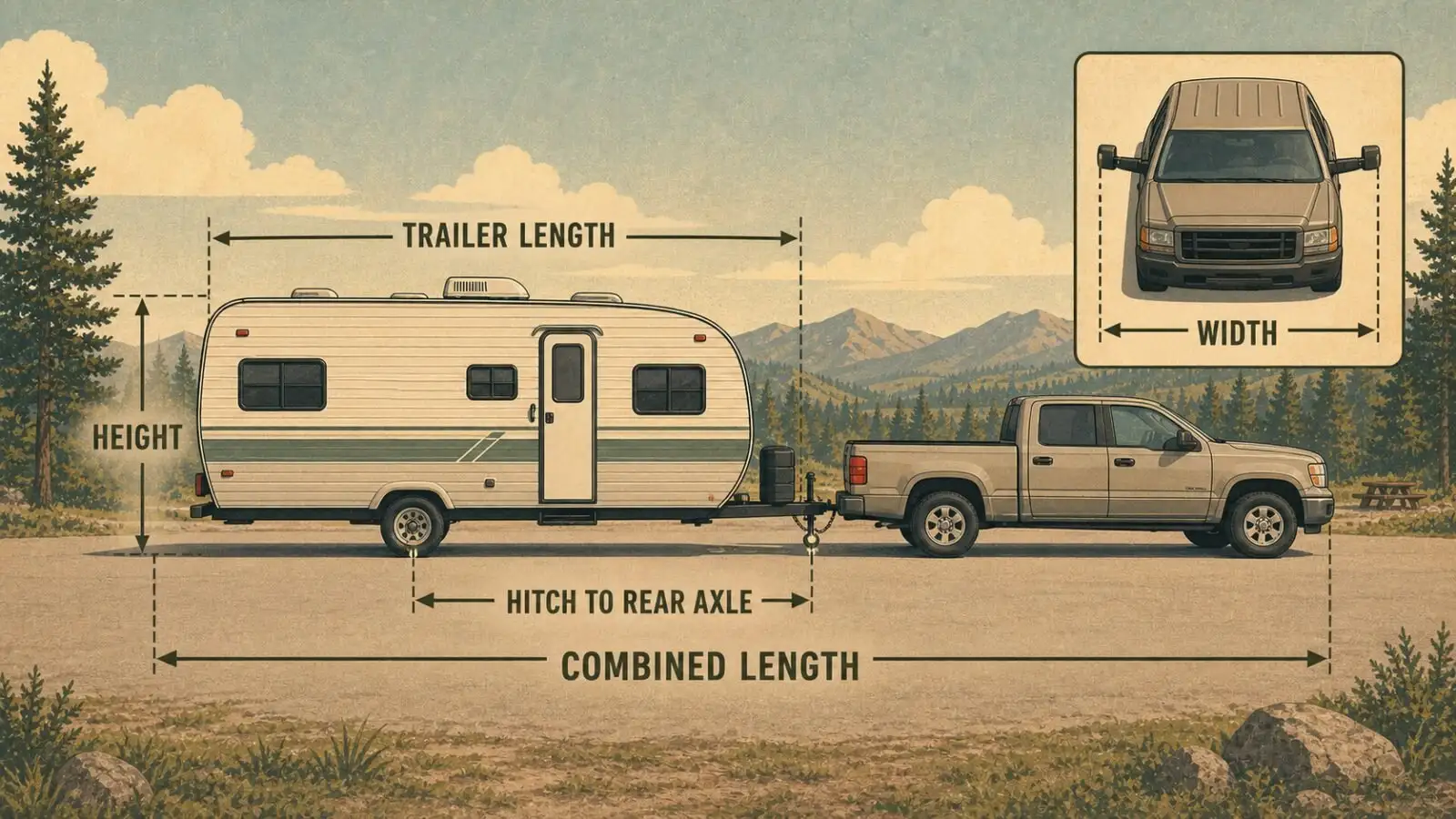
- Measure length bumper-to-bumper, hitched. One continuous measurement at ground level from the forward-most point (front bumper or brush guard) to the rearmost point (rear bumper, rack, ladder, or spare — whichever sticks out farthest). This is your combined/total length.
- Measure each unit separately too. Motorhome or trailer alone, coupler or kingpin to rear bumper, and tow vehicle alone. Some site records cap each piece of equipment separately, as in the Elk Creek example above.
- Measure hitch to rear axle for a trailer. Keep this separate from trailer body length. Zion’s current combination rule uses the distance from the hitch to the trailer’s rear axle, so a bumper-to-bumper figure alone cannot answer that route test.
- Measure width at the mirrors. Mirror tip to mirror tip in driving position, since official road definitions at Glacier and Zion count exterior attachments. If another fixed or travel-position item protrudes farther, use the widest figure; Zion’s current page explicitly includes mirrors, tires, air-conditioning units, bike racks, satellite dishes, and other aftermarket attachments.
- Measure height to the tallest roof item. Air conditioner, satellite dome, antenna, or roof rack load — whichever is highest, measured from the ground.
- Get a real weight. Weigh the loaded rig at a certified scale. Weight limits exist on real routes — Zion’s 50,000-lb figure is the current published example — and a brochure dry weight is not your travel weight.
- Write a measurement card. Six lines: combined length, RV/trailer-only length, hitch-to-rear-axle length, widest travel width, height, and loaded weight. Round up to the next inch, never down. Keep it with your booking accounts and in the cab.
- Re-measure after any change. New bike rack, different tow vehicle, added cargo box — the card is stale the day the rig changes.
What you actually need to do this properly
Three tools cover every measurement above. Item names link to Amazon search results, not to a single product, so you can compare current options and prices yourself. These are affiliate links, and nothing in this protocol changes because of them.
- A 25 ft tape measure — anything shorter forces you to measure in segments, and segment errors are what put a 41 ft rig into a 40 ft site.
- A laser distance measure — faster and more repeatable for height and width, and it lets one person measure a coupled rig alone.
- A height reminder decal for the cab — your measured height is only useful if it is in front of you at the underpass, not on a card in a drawer.
How to read a Recreation.gov site record
Individual site pages on Recreation.gov carry several size-related fields at once, and the Elk Creek A18 record linked above shows the full anatomy: permitted equipment types with a max length for each, a driveway length, a driveway entry type (back-in or pull-through), a driveway surface, a site length, a site width, and a maximum number of vehicles. Read them in this order:
- Permitted equipment first. If “RV (Max length: 22 ft.)” is listed and your motorhome measures 25 ft 7 in, the driveway length is irrelevant — the equipment cap already excludes you.
- Driveway or pad notes against your hitched number. A field label by itself does not prove one nationwide meaning. Where the site’s official note explicitly defines the driveway or pad as the total package space — as the Fort Pickens record does — treat that stated space as a hard ceiling for the whole package.
- Entry type against your skills and rig. A back-in figure and a pull-through figure of the same length are not equally usable for every driver and every trailer.
- Vehicle count. Records also cap how many vehicles a site may hold — Yellowstone’s Mammoth record, for example, requires all wheeled vehicles including trailers and motorcycles to be parked on pads or established roadways.
- Site alerts last. Free-text notes can carry the decisive detail; the Fort Pickens record flags a tree that can block right-side slides. Read them every time.
When a record’s fields appear to conflict — a generous driveway behind a small equipment cap — the restrictive field governs your booking decision, and the campground’s contact line is the tiebreaker. We apply the same restrictive-field rule in our campground finder entries.
Worked examples
These are illustrative calculations using the measuring protocol above and the officially published definitions linked in the decoder table. They are not universal rules, and the limits cited are examples current as of August 2, 2026 — confirm every figure on the official record before booking.
Example 1 — Truck and travel trailer (calculation)
A pickup measures 19 ft 2 in. A travel trailer measures 26 ft 8 in from coupler to rear bumper. Hitched, the single bumper-to-bumper tape reads 44 ft 6 in (slightly less than the sum, because the coupler rides over the hitch). Against combined-length definitions: this rig fits a 60-ft combined listing and a 45-ft combined listing, misses a 30-ft winter figure, and is far over Lewis Lake’s 25-ft total. Against Glacier’s road rule, the combination is well over 21 ft, so the restricted road segment is off the table regardless of where they camp. One rig, four different answers..
Example 2 — “24-foot” Class C with a bike rack (calculation)
A Class C sold as a 24-foot model measures 25 ft 7 in bumper-to-bumper once the rear bike rack is loaded. Against a per-equipment field of “RV (Max length: 25 ft.)” like Elk Creek site A02’s official Recreation.gov record, the measured rig is over the cap even though the brochure number is under it. Against Lewis Lake’s strictly enforced 25-ft total, same result. The 19-inch gap between marketing length and measured length is exactly what the protocol exists to catch.
Example 3 — Truck and fifth wheel against site geometry (calculation)
A truck measures 20 ft 4 in; a fifth wheel measures 32 ft 0 in pin to bumper. Hitched, the overlap over the truck bed brings the package to roughly 47 ft. At a site listing a 36-ft driveway with per-equipment caps of 22 ft — the Elk Creek A18 profile — this rig fails twice: the trailer alone exceeds the equipment cap, and the package exceeds the driveway. A long driveway does not make up for exceeding the equipment cap, and a generous cap does not help if the driveway is short.
Print this guide: pre-booking checklist
- Measure hitched, bumper-to-bumper, including racks and carriers — record to the inch, rounded up.
- Measure RV-only and trailer-only lengths separately.
- For a trailer, measure hitch to rear axle as a separate route-planning number.
- Measure width at mirror tips (or widest protrusion) and height at the tallest roof item.
- Weigh the loaded rig at a certified scale.
- Write the six-line measurement card; date it.
- Open the official record for the exact site or campground — not a summary page.
- Identify which definition the record uses (combined, total, per-equipment, driveway/package).
- Compare your card against the restrictive field, not the generous one.
- Check the route separately: does any road on your approach publish its own length, width, height, or weight limit?
- Re-verify the record’s figures the week you travel — limits, seasons, and road rules change.
This checklist pairs with the park-by-park records in our campground finder, the trip templates in weekend RV trips, and the park-specific fit guides in our national parks camping hub; broader planning fundamentals live in the RV camping section.
Frequently asked questions
How do I measure my RV for campground length limits?
Hitch up exactly as you travel, with the trailer or towed car connected and the bike rack, cargo carrier and anything else that rides outside already loaded. Take one continuous measurement at ground level from the forward-most point to the rearmost point — that is your combined or total length. Then measure each unit separately, because some site records cap each piece of equipment on its own. Record width with mirrors and height to the tallest roof item at the same time.
Why do campgrounds list different maximum lengths?
Because parks and booking systems use at least five different definitions: combined length, total vehicle length, per-equipment maximums, driveway length, and road limits that count bumpers and mirrors. The same rig can pass one definition and fail another, and there is no universal national definition. Match your measured numbers against the definition printed on the specific record you are booking.
Does the campground maximum mean my site will fit?
No. A headline figure describes the largest space in the facility, not every site in it. Read the permitted equipment field first: if a record lists an RV maximum of 22 feet and your motorhome measures 25 feet 7 inches, the driveway length is irrelevant because the equipment cap already excludes you.
Do mirrors and bumpers count toward the limit?
On some roads they do. Glacier’s Going-to-the-Sun Road restriction is written as vehicles and vehicle combinations longer than 21 feet including bumpers, or wider than 8 feet including mirrors. That is why the measurement protocol records width at mirror tips and length at the outermost point, rather than using brochure dimensions.
Limitations, and how to correct us
This guide reflects official pages as they read on August 2, 2026. It deliberately makes no claim of a universal national definition, no predictions about how any park enforces its limits on a given day, and no statements about live site availability. The park-specific figures cited (Yellowstone’s table values, Lewis Lake’s 25 ft, Colter Bay’s 45 ft, Glacier’s 21 ft/8 ft road rule, Zion’s June 7, 2026 route limits, and the Recreation.gov site examples) are examples of definition styles and are all volatile — each links to its official source, and each should be re-confirmed there before you rely on it. We did not physically measure any rig or site; the worked examples are labeled calculations built on the published definitions. Where official fields conflict on a record, we advise using the restrictive field for conservative planning and contacting the facility, rather than asserting a universal interpretation.
If you find an error, or an official source has changed since our fact-check date, tell us and we will correct the article and log the change per our editorial policy and corrections policy. Our sourcing standard is documented on the data sources and methodology page.
Sources
- National Park Service — Yellowstone campgrounds
- National Park Service — Going-to-the-Sun Road 2026 season
- National Park Service — Zion large-vehicle rules
- Recreation.gov — Lewis Lake Campground record
- Recreation.gov — Fort Pickens site record
- Recreation.gov — Site record example
- Grand Teton Lodge Company — Colter Bay RV Park
- Ticheka — Data sources and methodology